


Any one here that uses architect in a more conventional approach ?
Less algorytmic , generated stuff....
There is some sloppy timing going on ,
would def. not use this as a live tool ...hope it will get better during beta
Architect beta for macOS, Windows, and Linux. 0.10.5 now available
-
 gentleclockdivider gentleclockdivider https://www.kvraudio.com/forum/memberlist.php?mode=viewprofile&u=203660
 - Banned
- 6787 posts since 22 Mar, 2009 from gent
Eyeball exchanging
Soul calibrating ..frequencies
Soul calibrating ..frequencies
-
gentleclockdivider gentleclockdivider https://www.kvraudio.com/forum/memberlist.php?mode=viewprofile&u=203660
- Banned
- 6787 posts since 22 Mar, 2009 from gent
Can someone just clarify why the value of the datasource 'data object isn't send after disconnectig (changed ) and reconnecting .
In reaktor whenever a constant value module is disconnected (changed ) and re-connected it updates automatically , in max we need a bang object .
Do I need a memory latch like in reakor core ?
In reaktor whenever a constant value module is disconnected (changed ) and re-connected it updates automatically , in max we need a bang object .
Do I need a memory latch like in reakor core ?
Eyeball exchanging
Soul calibrating ..frequencies
Soul calibrating ..frequencies
-
- KVRAF
- 2000 posts since 5 Jan, 2003 from Brookings, OR
Wow, LOVELY! Thank you…woggle wrote: Sat Jan 05, 2019 12:51 am I also do things like take a recording of a piece by someone, reverse it, put distortion/reverb to smear out the pitch information, then extract pitch using Melodyne pitch to midi and orchestrate that result - using the errors to generate novelty
eg https://soundcloud.com/greghooper/varia ... paisajes-2
-
- KVRAF
- 1602 posts since 14 Oct, 2002
Hi all, i'm trying to send a little sysex message to one of my external hardware synths.
It seems that "pack sysex" wants arrays and not tuples. So the problem is that i want send a sysex message with a variable value controlled by a slider. Would a thing like send a tuple (index, value) to an array work? And then send an array to the "pack sysex". If pack sysex support tuples would be far straightforward
It seems that "pack sysex" wants arrays and not tuples. So the problem is that i want send a sysex message with a variable value controlled by a slider. Would a thing like send a tuple (index, value) to an array work? And then send an array to the "pack sysex". If pack sysex support tuples would be far straightforward
-
- KVRAF
- Topic Starter
- 2728 posts since 25 Aug, 2003 from Bournemouth, UK
This is how it works:gentleclockdivider wrote: Sat Jan 05, 2019 2:09 am Can someone just clarify why the value of the datasource 'data object isn't send after disconnectig (changed ) and reconnecting .
`data` objects (and the like) send an event during setup phase (if their setup event property is checked), which will occur when first connected. A setup will also occur after a reset. They will also send if their value is changed, or if they are double-clicked.
Architect, the modular MIDI toolkit, beta now available for macOS, Windows, and Linux.
-
- KVRAF
- Topic Starter
- 2728 posts since 25 Aug, 2003 from Bournemouth, UK
Yes, you got it, use the array.lalo wrote: Sat Jan 05, 2019 8:31 am Hi all, i'm trying to send a little sysex message to one of my external hardware synths.
It seems that "pack sysex" wants arrays and not tuples. So the problem is that i want send a sysex message with a variable value controlled by a slider. Would a thing like send a tuple (index, value) to an array work? And then send an array to the "pack sysex". If pack sysex support tuples would be far straightforward
Architect, the modular MIDI toolkit, beta now available for macOS, Windows, and Linux.
-
- KVRAF
- 1602 posts since 14 Oct, 2002
Thanks Colin. All my attempts are giving errors like
build array: array contains elements of mixed types
I'm trying to build an array of 2 elements sending [build array] two tuplets
(0, 127) and (1, slider value).
Is there an example? (i'm coming from Max/Pd so i have to be a little used to different event priority etc.)
BTW a couple of request
1. A way to write values in [data] objects directly on the graph without going to [data] properties panel
2. Some kind of "loadbang" init signal. Is [signal] this kind of thing? I need to fill some arrays at init time.
-
- KVRAF
- Topic Starter
- 2728 posts since 25 Aug, 2003 from Bournemouth, UK
Sliders output float types and your array is integer. Array building is (I think) the only case where numeric types are treated differently because by knowing if an array if integer or float, other bits can be optimised.
So first off, I'll enhance that error message to make it clear that it is mixed numeric types.
What you need to do is cast your slider outputs to integer.
BTW a couple of request
Already on the list as I think someone else asked for this a few days back.1. A way to write values in [data] objects directly on the graph without going to [data] properties panel
You can use the 'on setup' module to do this, or just ensure that the data modules have their setup event property enabled and they will do this automatically.2. Some kind of "loadbang" init signal. Is [signal] this kind of thing? I need to fill some arrays at init time.
Architect, the modular MIDI toolkit, beta now available for macOS, Windows, and Linux.
-
- KVRAF
- 1602 posts since 14 Oct, 2002
Thanks.colin@loomer wrote: Sat Jan 05, 2019 10:55 amSliders output float types and your array is integer. Array building is (I think) the only case where numeric types are treated differently because by knowing if an array if integer or float, other bits can be optimised.
So first off, I'll enhance that error message to make it clear that it is mixed numeric types.
What you need to do is cast your slider outputs to integer.
BTW a couple of requestAlready on the list as I think someone else asked for this a few days back.1. A way to write values in [data] objects directly on the graph without going to [data] properties panel
You can use the 'on setup' module to do this, or just ensure that the data modules have their setup event property enabled and they will do this automatically.2. Some kind of "loadbang" init signal. Is [signal] this kind of thing? I need to fill some arrays at init time.
I'd add an option to [slider] to set wich kind of data generates. Casting with [to integer] is possible but i think that in case of UI objects would be better to have integer/float options.
-
- KVRAF
- Topic Starter
- 2728 posts since 25 Aug, 2003 from Bournemouth, UK
Yeah, why didn't I think of that! Good call, thanks.lalo wrote: Sat Jan 05, 2019 11:18 am I'd add an option to [slider] to set wich kind of data generates. Casting with [to integer] is possible but i think that in case of UI objects would be better to have integer/float options.
Architect, the modular MIDI toolkit, beta now available for macOS, Windows, and Linux.
-

- KVRian
- 642 posts since 22 Jun, 2018
Maybe automatically output integers if the interval property is set to an integer? The interaction between the two settings could become confusing otherwise, I suppose.
-
- KVRAF
- Topic Starter
- 2728 posts since 25 Aug, 2003 from Bournemouth, UK
And if the minimum and maximum are and defaults are all integers. Let me think about it...
Architect, the modular MIDI toolkit, beta now available for macOS, Windows, and Linux.
-
- KVRian
- 642 posts since 22 Jun, 2018
Ahh yeah, those would have to integers too, I didn't think of that.
-
- KVRian
- 911 posts since 10 Dec, 2013
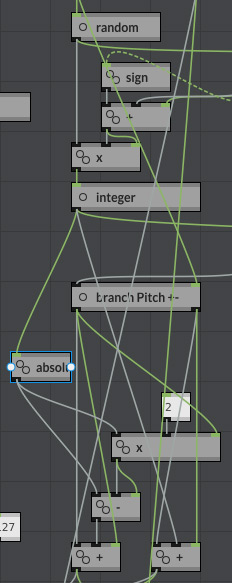
You can use the data thru object to pass data unaltered, group multiple wires into a single one etc to help with organisation a bit, but I agree that wire nodes would also help for general cleaning.ThomasHelzle wrote: Fri Jan 04, 2019 10:21 pm My Midi Manglers graph became quite a mess in some parts and I haven't found a "paradigm" yet that allows me to build a clean structure - which I'm normally a big fan of.
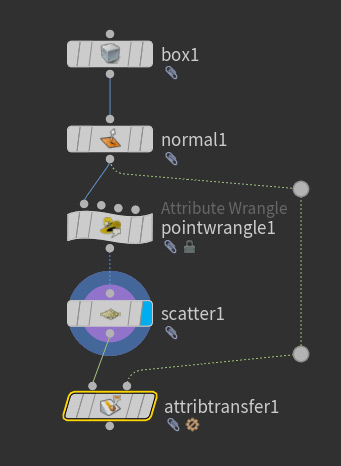
Part of it is the "jumping data input" we discussed already where wires cross a lot, since the main data wire doesn't stay always on the left, but part also is, that there is no "wire dots". This is how they look in Houdini:
Those dots (on the right) can be placed with ALT-clicking on a wire, can be dragged wherever one wants and allow to create really clean and clear structures where normally the wires would overlap other nodes. They don't do anything to the signal and are purely organisational.
Cheers,
Tom
-
- KVRAF
- 1794 posts since 29 Sep, 2013
I know its pretty basic for you guys, but I'd like to know if there's an lfo modulation unit already existing somewhere within Architec.
I presume one would have to build his own but want to be sure that I didn't miss it in the first place...
I presume one would have to build his own but want to be sure that I didn't miss it in the first place...