


I'm not understanding it well enough, because I can't see where the input line going into the bottom Steps is coming from, and I don't know which of the two bottom Steps' modulators are going. (Obviously to the Follower, but which knobs exactly?) And why is the bottom Steps feeding back into the top red Steps?x.iso wrote: Tue May 14, 2019 11:43 pm Here's the most compact MSEG idea I've thought so far. Could be used in various ways, depending on what you wire to Phase input of Step sequencers (or just leave Grid Phase). First one generates regular step parameter change, and two others adjust Rise and Fall of env. follower to make some steps curved to various degrees as the sequence goes.
The Grid: Tips and Tricks
-
- KVRian
- 909 posts since 7 Nov, 2017
-
- KVRist
- 235 posts since 13 Dec, 2016 from Tucson, AZ, USA
I haven'th gone that far yet, but there are ways to send audio, data and clock in and out of each instance.NothanUmber wrote: Tue May 14, 2019 8:39 pm Have started experimenting with the BW3 beta today - looks promising!
Is there an option to add groups/"subgrids" to structure more complex stuff?
So yes, I suspect you could get that crazy.
-
- KVRist
- 401 posts since 27 Mar, 2019 from stuck in Russia
I guess I should have cleared the Phase in wires before taking the screenshot for generic patch idea.Yokai wrote: Wed May 15, 2019 12:08 am I'm not understanding it well enough, because I can't see where the input line going into the bottom Steps is coming from, and I don't know which of the two bottom Steps' modulators are going. (Obviously to the Follower, but which knobs exactly?) And why is the bottom Steps feeding back into the top red Steps?
As I've said, first sequencer (top one) is used as is and patched into Envelope follower, there by twisting Rise and Fall we could make curves for changing values, that's what other two sequencers do.
If Gird Phase used, then by default they go in sync and you can easily define which step is curved and how, although this method lacks visual control on what you're doing, so the scope will help with getting it into right shape.
By using alternative Phase generators like Transport of Counter (coupled with Gates or something), you could make shapes with all kinds of timings.
In my example I've experimented with cross-wiring the sequencers Phases to shake them up, and bottom one is receiving other Envelope follower signal coming form the synth output.
-

- KVRAF
- 26961 posts since 3 Feb, 2005 from in the wilds
I've played with that setup too...x.iso wrote: Tue May 14, 2019 11:43 pm Here's the most compact MSEG idea I've thought so far. Could be used in various ways, depending on what you wire to Phase input of Step sequencers (or just leave Grid Phase). First one generates regular step parameter change, and two others adjust Rise and Fall of env. follower to make some steps curved to various degrees as the sequence goes.
Also, simply multiplying 2 LFO's or an LFO and an Env (triggered in various ways) can create so many MSEG type shapes by adjusting timing and phase between them.
The really fun thing with all these sorts of setups is that the shapes can be modulated where MSEG's are basically static shapes.
-
- KVRian
- 909 posts since 7 Nov, 2017
Thanks, y'all for the clarifications. Yeah I've been interested in this technique as a way to have a basic MSEG shape but then to modulate the shape itself. Emma showed something similar on the Discord with two ADSR envelopes. Still wrapping my head around the concept and technique. 
EDIT: Tried both techniques, and while you can get some interesting shapes, it's *not* anything like doing hand-drawn MSEG shapes. We still need a bonafide MSEG module that you can draw on directly, like LFOTool or GateKeeper or Serum LFOs or Pigments functions, etc.
EDIT: Tried both techniques, and while you can get some interesting shapes, it's *not* anything like doing hand-drawn MSEG shapes. We still need a bonafide MSEG module that you can draw on directly, like LFOTool or GateKeeper or Serum LFOs or Pigments functions, etc.
Last edited by Yokai on Wed May 15, 2019 4:28 am, edited 1 time in total.
-
- KVRist
- 401 posts since 27 Mar, 2019 from stuck in Russia
If you set LFO rate to hold and modulate it's phase, then you can make it kinda one-shot, but at this point when you have to make a one-shot phase generator, would you really need LFO anymore? Well, for additional modulation I guess.pdxindy wrote: Wed May 15, 2019 3:43 am One thing I would like is for the LFO to have a one-shot mode. The ADSR cannot go very slow.
Steps could use a one shot mode as well...
You do not have the required permissions to view the files attached to this post.
-
- KVRian
- 909 posts since 7 Nov, 2017
The simplest, easiest way to get true hand-drawn MSEG into The Grid. Put Gatekeeper in CV Out mode and then pull in its CV signal through the Audio Sidechain module.
This is why we need a hand-drawn MSEG module. Because nothing in The Grid itself today can do this with speed and precision.
This is why we need a hand-drawn MSEG module. Because nothing in The Grid itself today can do this with speed and precision.
You do not have the required permissions to view the files attached to this post.
-
- KVRian
- Topic Starter
- 911 posts since 10 Dec, 2013
Just to play devil's advocate, I quite admire the way Bitwig have stubbornly refused to add an MSEG. I feel like a lot of modern EDM has become overly dependent on the MSEG/grid drawing type approach to generate modulation signals, it's good to force oneself to try different approaches from time to time.
Ofc I'm half kidding though - lots of people do very interesting things with MSEGs, they're another great tool in the toolbox.
Ofc I'm half kidding though - lots of people do very interesting things with MSEGs, they're another great tool in the toolbox.
-
- KVRian
- 909 posts since 7 Nov, 2017
MSEG envelopes/LFOs are popular for a reason. Bitwig would be unwise to purposely avoid giving us one, both in The Grid *and* as a new Modulator type among the current set of modulators.Hez wrote: Wed May 15, 2019 9:20 am Just to play devil's advocate, I quite admire the way Bitwig have stubbornly refused to add an MSEG. I feel like a lot of modern EDM has become overly dependent on the MSEG/grid drawing type approach to generate modulation signals, it's good to force oneself to try different approaches from time to time.
Ofc I'm half kidding though - lots of people do very interesting things with MSEGs, they're another great tool in the toolbox.
-
- KVRAF
- 5144 posts since 3 Oct, 2013
just a remark, a new VST-plugin/VST-host, has been added, which knows exactly this
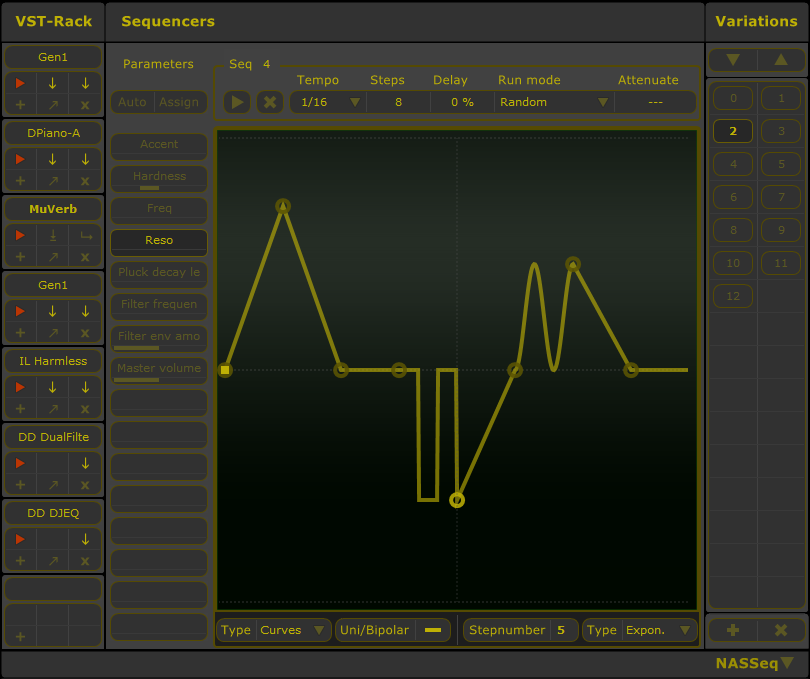
https://www.kvraudio.com/product/nasseq ... evelopment
https://www.kvraudio.com/product/nasseq ... evelopment
"Where we're workarounding, we don't NEED features." - powermat
-
- KVRAF
- 26961 posts since 3 Feb, 2005 from in the wilds
That is not a one shot... it still keeps going and repeats.x.iso wrote: Wed May 15, 2019 4:25 amIf you set LFO rate to hold and modulate it's phase, then you can make it kinda one-shot, but at this point when you have to make a one-shot phase generator, would you really need LFO anymore? Well, for additional modulation I guess.pdxindy wrote: Wed May 15, 2019 3:43 am One thing I would like is for the LFO to have a one-shot mode. The ADSR cannot go very slow.
Steps could use a one shot mode as well...
-
- KVRAF
- 26961 posts since 3 Feb, 2005 from in the wilds
I'm not arguing against an MSEG module... however, most of the usual shapes someone makes with an MSEG are fairly easy to do right now. It does take more mental visualization and learning. There are benefits though to not using an MSEG.Yokai wrote: Wed May 15, 2019 3:35 amEDIT: Tried both techniques, and while you can get some interesting shapes, it's *not* anything like doing hand-drawn MSEG shapes. We still need a bonafide MSEG module that you can draw on directly, like LFOTool or GateKeeper or Serum LFOs or Pigments functions, etc.
-
- KVRist
- 401 posts since 27 Mar, 2019 from stuck in Russia
If you look closely, the shape repeats because there are 2 consecutive steps in Gates, then goes off just once at 1 separated step. But I get what you mean, you need gate timed to the length of the Phase. There is a Gate length module, but it operates in seconds instead of steps. This is especially frustrating since Clock module have frequency instead of either sync or time, you technically can set up a Phase pulse of certain length and Gate that only gets out one pulse at a given trigger, but it's a royal pain with this inconsistency of timing value typespdxindy wrote: Wed May 15, 2019 2:39 pmThat is not a one shot... it still keeps going and repeats.x.iso wrote: Wed May 15, 2019 4:25 amIf you set LFO rate to hold and modulate it's phase, then you can make it kinda one-shot, but at this point when you have to make a one-shot phase generator, would you really need LFO anymore? Well, for additional modulation I guess.pdxindy wrote: Wed May 15, 2019 3:43 am One thing I would like is for the LFO to have a one-shot mode. The ADSR cannot go very slow.
Steps could use a one shot mode as well...
-
- KVRist
- 401 posts since 27 Mar, 2019 from stuck in Russia
Well technically you can just draw MSEG in a midi clip as automation and use it in clip launcher. There you can set up loop region that doesn't coincide with starting position, etc. But certainly you can't use it as a curve mapper.Yokai wrote: Wed May 15, 2019 11:00 am MSEG envelopes/LFOs are popular for a reason. Bitwig would be unwise to purposely avoid giving us one, both in The Grid *and* as a new Modulator type among the current set of modulators.