
What u-he instrument can do this ?

Official support for: u-he.com
Post Reply New Topic
RELATED
PRODUCTS

Post

I've just started studying FM Synthesis and I wanted to re-create my favourite DX7 sounds.
In the future I'm thinking of buying a u-he synth vst, the DX7 algorithm 16 puzzles me, it has 1 carrier and 5 modulators, what u-he instrument would be best for this and how ?

I also know that the DX7 used Phase Modulation, strange as I thought it would use FM.
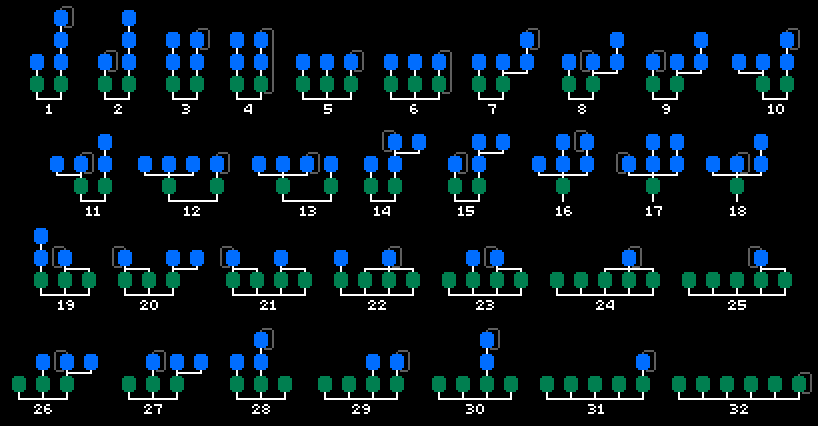
Image

Post

Not entirely 1:1 replica but Hive2 is the closest to handle this.

Check these threads:
viewtopic.php?t=511639

Plugmon awesome FM & PD sound pack for Hive2
https://rekkerd.org/plugmon-releases-fm ... u-he-hive/

Post

DefiantCatz70 wrote: Tue Jun 08, 2021 10:21 pm wanted to re-create my favourite DX7 sounds.
maybe have a look at dexed?

https://asb2m10.github.io/dexed/

Post

You could conceivably do it in Bazille utilizing filters as operators if you wanted to be a DX purist, but it'd be more of PITA than it's worth, IMO. (brief aside, most "FM" synths are actually PM -- there are minor differences, but effectively they are the same thing). Zebra can also emulate most of the algorithms.

Anyway, FM is one of those things I've studied in great depth. So let me try to give you a little insight. In the DX7, all operators are sine waves. When you stack a bunch of modulators, an explicit goal is being put forth: to combine simple waveforms into a complex waveform with which to modulate a carrier.

Here's the time-saving insight: it's possible to cut out the middle man. Instead of combining multiple operators using simple waveforms to collectively make one complex waveform, just use one modulator and start with a complex waveform and modulate the carrier with that. From this perspective, Zebra more than adequately covers almost all FM needs, aside from those desiring the FMO module to allow the use of arbitrary waveforms or samples.

Now, that doesn't mean studying DX-style FM isn't worthwhile -- I strongly encourage it actually, because you'll have a much greater appreciation of how to use Zebra effectively if you do. Really dig in and learn how to get as much out of every operator in every algorithm that you can, there are a lot of nifty tricks you can pull off with multiple modulators. But understand it can be summarized like this: operators with simple waveforms (either static or time-varying) combine to make complex waveforms with which to transform one or more carriers. That's all. You can do the same with Zebra, without needing fixed chains of DX algorithms or a matrix editor, while having the additional advantage of Zebra's other sound modules and robust MSEGs, LFOs, and so on.

Anyway, to learn DX style FM, I suggest both Dexed (free) and a second-hand copy of FM8 (often can be found very cheap). I learned off of both -- Dexed for importing/analyzing DX7 patches, and FM8 for programming my own sounds. I highly encourage picking up FM8 since the matrix editing gives you significantly more flexibility and power than fixed algorithms (that said, restricting yourself to DX algorithms at first is a great way to discipline yourself and gain a firm understanding of how things work, so start there). It's a great synth and will nicely complement any u-he synth you eventually decide to pick up.

Post

Zebra can do almost all of these algorithms easily, with few exceptions:

Algorithms 4 and 6 are not possible, because the feedback spans farther than 1 operator.
Algorithms 19, 21 and 22 would require a 5th FMO.

If the "normal" oscillators in Zebra are used with a sine wave and the scrambler OscFX, all harmonic FM feedback can be replicated, hence algorithms 19, 21 and 22 are possible again for those types of sounds. This excludes none-harmonic FM feedback, which resembles noise. In those cases, a noise module can be used instead.

Hence, effectively, Zebra can do all DX-7 algorithms except 4 and 6.

It has however never been the goal of any of our plug-ins to exactly replicate the DX-7 or its siblings, but as others mention, there are many plug-ins that should get the job done just fine. To the contrary, Bazille was designed to show that this type of synthesis should not by "type cast" to the restrictive architecture depicted in these algorithms. It has sonic capabilities way beyond the DX architecture. Likewise, while Zebra's FMO modules open up the possibility to create almost any algorithm thinkable beyond those 32 (with exceptions mentioned), what interested me most was the interaction of phase modulation with other types of synthesis. That is, in Zebra, FM carriers are not restricted to FM oscillators as modulators, it's possible to use wavetables, noise, comb filters (physical modeling) and each of these with or without filters, ringmodulation, distortion or any type of processing available between modulators and carriers.

Post

In Zebra you could use regular oscillators for the operators on the left and top centre, and FMOs for the other 4.Then a couple of MIX modules are required to feed the carrier. However, Zebra is an allrounder: For DX-style FM plus a few extras you should also try Traktion "f'em".
Last edited by Howard on Mon Jun 14, 2021 8:25 am, edited 1 time in total.

Post

I've checked out Dexed and it's great that I can load the original sysex, and thanks to everyone's replies, it's given me great insight how to maybe re-create these sounds, but in a different way compared to the DX7.
For sound designing I just use my ears to compare from the original, just wondering if a spectrum analyzer would help me see each frequency better or any software out there that can do that.
Traktion "f'em" looks goods, cannot see anything about using the syx, as this would be good to check out the settings.
All the videos of u-he products sound great.

Post

DefiantCatz70 wrote: Wed Jun 09, 2021 11:05 am Traktion "f'em" looks goods, cannot see anything about using the syx, as this would be good
there is a dedicated f'em thread in the instruments section
viewtopic.php?f=1&t=565955

with the dev wolfram franke participating...

Post

For more complex feedback stuff, I saw that Massive X offers routing options that allow this. At least per-voice feedback. But it also has some SSE requirement for the CPU. What's also cool is, if feedback is possible from the global FX (especially Reverb) into the voice. NI Kontour allows this for example and it's cool e.g. for mimicking the effect of holding a guitar close to the speaker so that the guitar strings get excited by the output.
Also when using feedback it's good to have some kind of nonlinearity in the feedback path. I have Bazille and I'm not sure but I think it doesn't have a per-voice waveshaper. Or is it possible there to misuse oscillators as waveshapers?

Post

I'll chime in.
Zebra can do excellent fm( phase modulation) but there is one mayor difference with the dx series .
On the dx series there is No such thing as FM amount input , the fm amount input is defined by the (modulator's)operator's output .
Zebra has as fm input , so if you really wan't to mimick the dx patches , set zebra's fm operator amount between 50-100% ( for the carrier)and modulate the volume output of the fm operator (modulator).
It gets more complicated when the modulator is also feedbacking itself , you the need to modulate both the fm input ( set to self feed) and also the operator's output ,by the same envelope .
Reason for this is because on the dx , the self feedback is tapped after the operator's envelope , iow a decrease in operator's gain( because of the envelope) will also decrease the amount of feedback send back to the operator.
You can also substitute a feedback operator with a sine + scramble
Let this sink in ..
Eyeball exchanging
Soul calibrating ..frequencies

Post

u-u-u wrote: Sun Jun 13, 2021 7:39 am For more complex feedback stuff, I saw that Massive X offers routing options that allow this. At least per-voice feedback. But it also has some SSE requirement for the CPU. What's also cool is, if feedback is possible from the global FX (especially Reverb) into the voice. NI Kontour allows this for example and it's cool e.g. for mimicking the effect of holding a guitar close to the speaker so that the guitar strings get excited by the output.
Also when using feedback it's good to have some kind of nonlinearity in the feedback path. I have Bazille and I'm not sure but I think it doesn't have a per-voice waveshaper. Or is it possible there to misuse oscillators as waveshapers?
Set the desired Bazille Oscillator mode to Multiply by 0, then feed it a PM input.

Post Reply

Return to β€œu-he”