Wave Alchemy Triaz [Kontakt]

Sampler and Sampling discussion (techniques, tips and tricks, etc.)
Post Reply New Topic
RELATED
PRODUCTS
Triaz$149.00Buy

Post

elxsound wrote: Fri Dec 24, 2021 10:17 pm Another congrats on the release. this looks impressive especially for a drum Kontakt instrument, for which there are already many (and obviously including several releases by you guys). Nice work (and definitely a nice “clean” UI).
Thanks Elxsound, we try our best and appreciate your comments :tu:
http://www.wavealchemy.co.uk

Specializing in the development of forward-thinking virtual instruments and sample libraries.

Post

Marcus Aurelius wrote: Sat Dec 25, 2021 7:26 pm Looks great... I love the flat UI. Much prefer that approach over skeumorphic designs (with the exception of things really attempting to accurately emulate hardware, in which case skeumorphic can make sense). It's also one reason I love Valhalla's plugins. (Of course, in the case of Valhalla and Wave Alchemy, most importantly is that products from both sound fantastic).
I do agree with you on this. Obviously everyone has their personal preferences on UI, but in general from a UX / Design point of view, and from the feedback we receive, this definitely seems to be the majority preference. I do agree also that Skeuomorphic design has it's place - for example when accurately emulating a piece of hardware and wanting to put across that same experience and feel to the user :tu:
http://www.wavealchemy.co.uk

Specializing in the development of forward-thinking virtual instruments and sample libraries.

Post

Martin Simon wrote: Mon Dec 27, 2021 9:00 am Now, I'm a person who likes to tune a drumkit to the scale of the song.
When I listen to the demos I hear a lot of tuned and tonal sounds. Is there an easy way to know how the samples are tuned(without using analysis tools, that is).
Are the samples structured in a tonal way?
The drums in TRIAZ are not tuned to a specific key. For this to work as suggested in any meaningful way, we'd likely need to pitch each and every drum to the same pitch in the instrument. All sounds in TRIAZ (all 10,000 of them) are designed or recorded from analogue and acoustic sources. We feel pitching these sounds digitally or in a destructive way on the actual raw content itself would be a very bad idea. We love the feel and analogue / live charm of the samples!

In TRIAZ, you can however play any drum over a 2 octave, chromatically pitched way for pitched drum patterns via MIDI - which is very useful for tom fills, snare rolls, musical percussion etc :D

Of course, you do have tuning controls for each drum (and each layer of each drum!) on the UI too.
http://www.wavealchemy.co.uk

Specializing in the development of forward-thinking virtual instruments and sample libraries.

Post

ChickenMan1 wrote: Mon Dec 27, 2021 11:07 pm I used to play with Drumvolution some time ago, and I liked it. Im thinking of buying the new Triaz and dl the demo. But for some reason changing samples is not as smooth as in drumvolution. When I'm looking for a different kick for example, I notice that after 3 attempts Triaz is no longer in sync with Bitwig's metronome, the same with FL. Drumvolution the changing of samples went much more fluently. Never had a sync issue there. Is it just me!?
Hi!

First off, the Demo Version is of course heavily limited, and sounds cannot be changed in the browser. The way sounds are browsed is vastly better in TRIAZ - since every sound is tagged by both drum type (i.e Kick acoustic, Kick electronic), and then a sub tag (i.e deep, room, Tape, Vinyl, Punchy etc).

We made it so that all samples are always visible for any given tag, without the need for a scroll bar.

With regards to the sync issue you are experiencing. We are aware of this and will provide a fix for the full version of TRIAZ in the next few days. This seems to happen in certain DAWS when changing drum sounds when Host Sync is activated and TRIAZ is played back via DAW controls. I personally don't like using Host Sync, since it is much more versatile to build a pattern in the sequencer and then export it as MIDI for further tweaking throughout a full song - but I get that a small user group do use this feature of course, and we'll be providing a fix for this very shortly as said above :D

The DEMO version had a minor bug (well, a very simple line of code we missed!) whereby it allowed you to open the browser when clicking the previous / next arrow, which is what you must have experienced. The DEMO version should not allow the opening of the Browser, and this has since been amended. If you download the Demo again, you'll see that this is now fixed! :tu:
http://www.wavealchemy.co.uk

Specializing in the development of forward-thinking virtual instruments and sample libraries.

Post

rossc wrote: Tue Dec 28, 2021 10:10 am
I bought it a few days ago and for the most part I like it, but I'm finding the same thing as you - if I try to change a drum sound Triaz quickly starts to lose sync with Cubase. Really hope this is something they can fix soon.
We'll be providing a fix for this within the next few days :tu:

In the mean time, I'd highly recommend building your pattern in TRIAZ's sequencer, and then exporting it as MIDI. This gives you much more power, and the Exported MIDI patterns gives you all the Slop, polyrhythmic and timing functions as heard when playing back from the sequencer - only now you can extend patterns more in your DAW, add fills, or whatever else. This is the way most use our instruments, including myself :tu:

Having said this, it won't belong until the fix arrives, and of course another thing you can do in the mean time is simply stop and re-start the sequencer if it drifts out of sync a bit - since this only happens when changing a sound whilst the seq is running in Host Sync mode.
http://www.wavealchemy.co.uk

Specializing in the development of forward-thinking virtual instruments and sample libraries.

Post

Looking forward to the fix, thanks!

Post

Does the Triaz sequencer still have the ability to control all of the parameters in the sequencer, things like pitch, like Drumvolution did? It seems unlikely that it would have been removed, but I can't find it. In drumvolution, there is a circle at the top-left of the sequencer that opens to more detail for just that lane... that's the one i mean. Thanks!

Post

wave alchemy wrote: Wed Dec 29, 2021 4:46 pmIn the mean time, I'd highly recommend building your pattern in TRIAZ's sequencer, and then exporting it as MIDI. This gives you much more power, and the Exported MIDI patterns gives you all the Slop, polyrhythmic and timing functions as heard when playing back from the sequencer - only now you can extend patterns more in your DAW, add fills, or whatever else. This is the way most use our instruments, including myself :tu:

Having said this, it won't belong until the fix arrives, and of course another thing you can do in the mean time is simply stop and re-start the sequencer if it drifts out of sync a bit - since this only happens when changing a sound whilst the seq is running in Host Sync mode.
I suspect you're underestimating how many of your users like to hear their drums play along with their tracks.

I don't doubt the utility of working on drums separately, exporting them, etc. But I also doubt that the majority of users work that way - drums entirely out of context of the other tracks.

Post

chroma wrote: Fri Dec 31, 2021 6:24 am Does the Triaz sequencer still have the ability to control all of the parameters in the sequencer, things like pitch, like Drumvolution did? It seems unlikely that it would have been removed, but I can't find it. In drumvolution, there is a circle at the top-left of the sequencer that opens to more detail for just that lane... that's the one i mean. Thanks!
Hi!

You can still sequence Pitch and Filter cutoff in TRIAZ (via velocity), but TRIAZ currently doesn't have a separate FX sequencer like Drumvolution did. It's something we can look add adding in the future if there is enough interest for it. But the reasoning behind this is that essentially TRIAZ is a completely different product to Drumvolution first and foremost (sounds very different too), and we wanted to improve the workflow a lot. In the new Engine, when you export a MIDI pattern, ALL MIDI data from the sequencer is exported and the pattern will sound identical in your DAW as it does in the TRIAZ sequencer. With FX sequencing in Drumvolution for example, you would lose the FX sequencing when exporting to MIDI. There is a workaround for this, but in short it requires the sequencer to continue running, and as such would add CPU and clutter. Something which we want to avoid in TRIAZ! A large portion of the feedback we received for Drumvolution for example was to make future instruments more responsive, quicker and CPU light. We've done this with TRIAZ, but is also much more powerful in many other ways too, of course!

You now have Host Automation per Drum, per layer for important controls such as filters, pitch, slop, random pan, envelope amounts, LFOs, FX sends, the volumes of each layer within a voice, etc etc :tu:
http://www.wavealchemy.co.uk

Specializing in the development of forward-thinking virtual instruments and sample libraries.

Post

padillac wrote: Fri Dec 31, 2021 6:36 am
I suspect you're underestimating how many of your users like to hear their drums play along with their tracks.

I don't doubt the utility of working on drums separately, exporting them, etc. But I also doubt that the majority of users work that way - drums entirely out of context of the other tracks.
Thanks for your reply.

To confirm, I'm not suggesting that you preview drums out of the context of your track. I'm simply saying that once a MIDI pattern is exported, you can then do exactly the same thing - change drums IN context with your track, alongside change the pattern etc. And I was just acknowledging that this is what the majority of people appear to be doing.

I am basing my previous message from the feedback and support questions we have received from many customers all the way back to 2016 - when Revolution was released. So this certainly seems to be the case with many of our customers at least :D

This is the exact reason why 'Host Sync' is disabled by default in the INIT preset in TRIAZ - based on this feedback.

Of course, lots of people also like to do things in the way in which you suggest, and it's why we have included this feature and kept it in TRIAZ. You have both options.

What I am referring to, is that a lot of people (again based on the same feedback) tend to find a preset they like, export it as MIDI quite quickly, and then tweak that further in their DAW alongside their track to make it perfectly fit. And assumedly then switching out and changing drums in TRIAZ at this stage - which of course can still be done in time with your music :tu:

I hope this makes sense and that you can see where I am coming from!
http://www.wavealchemy.co.uk

Specializing in the development of forward-thinking virtual instruments and sample libraries.

Post

TRIAZ vs Drumvolution - Explained

Hey Guys,

So, we've had quite a few Drumvolution customers contact us recently - some seemingly confused as to the differences between TRIAZ and Drumvolution, and asking why TRIAZ is a new product and not an update. etc.

I have created a clear list below which hopefully makes this clear. If this is helpful to you, let me know or give this post a thumbs up, and I will look at sending an email to Drumvolution customers with a similar comparison:

First and foremost, TRIAZ is a completely different product to Drumvolution. No code was used from Drumvolution, and everything was built entirely from the ground up. here are some highlights of the differences:


1. The sound content that powers TRIAZ is all new, and very different to the sounds that power Drumvolution. The TRIAZ library is a clear cut above Drumvolution. Better in almost every way, and much more versatile. It is truly our best work to date, by far! It was a real labor of love for us :tu:

First and foremost, we are extremely passionate about sound design. As well as our own products, you've likely heard our sound design in many other products. For Example: Logic Pro & Bitwig, the entire content for Analog Dreams and Hybrid Keys by NI, or more recently the factory content and sound design for Roland's SP-404 MKII - to give a few examples.

With TRIAZ we invested close to £100K on the sound design over a period spanning years. In addition to the instrument itself, you get access to all of the sound design and samples as WAV files, in well organized folders -to use in any DAW or software of your choice. Hopefully this one point alone shows you why we didn't simply update Drumvolution. Due to the vast effort in sound design and recording, it makes absolute sense to have TRIAZ as it's own unique product. Just like how for example Spitfire Audio has not one, but a variety of different sounding string libraries.

Other products mentioned in this thread (and most software drum machines in general) will most often simply license their sound content from existing sample libraries, such as NOIIZ, Sample Magic, Splice, Loopmasters, etc. Meaning you're essentially paying for sounds that are available elsewhere (often for many years). or that you may even have bought already. This is one of the main things that sets TRIAZ and our instruments apart, which people often seem to miss.


2. The user interface / workflow is quite different and more streamlined in TRIAZ. Making it much quicker to build beats and layer drums. It also has a significant reduction in CPU / RAM usage compared to Drumvolution, and is much more responsive.

3. In the new layering engine, any sound can now be layered with any other. In Drumvolution we were forced to only layer a drum with either a transient and layer sound. Now in TRIAZ you can layer any sound with any other - which is super powerful. The Layer engine itself is also quite different and designed in a way that makes layering sounds much faster and easier.

4. Randomization features - TRIAZ features some powerful randomization features. For example you can load a preset and change it into something completely new and great sounding, with just one click. You can randomize in the following ways:

Individually randomize drums using only similar sounds
Individually randomize drums using different sounding drums
Randomize the same layer on all 12 channels
Randomize the entire 3 layers on just one channel
Randomize the entire drum kit using similar sounds
Randomize the entire drum kit using different sounds
Additionally, if you like a sound. You can lock any drum so that it doesn't get included in any randomization.

5. All new effects engine. Different reverb impulses, a new algorithmic reverb, new Delay. Different master effects section. A new 'Noise' feature on the output allowing you to introduce tape, vinyl noise and many others directly into the master signal to dirty things up.

6. New tag based browser - It is now very different and much easier to browse drums - everything can be visually seen and no scroll bar is used at all. You can also favorite drums for easy recall.

7. Sample Reverse feature

8. user Sample Import

9. Completely new sequencer. TRIAZ's sequencer has individual step length and Step speed per lane. This allows for super complexe polyrhythms and organic sequencing. Furthermore, it has note chance per step, per lane, note repeat per step, per lane (for triplets, stutter effects etc per sound), a new Slop engine allowing you to easily humanize the patterns etc, and much more.

10. You additionally get access to all the raw wav samples, well organized when purchasing TRIAZ. Nothing is locked like in Drumvolution,

11. 600 Presets. We put a massive effort into presets in TRIAZ.

12. Individual sections like Filter can be completely bypassed to reduce CPU further if not using them.

There's more differences, but these are some of the highlights :tu:

One last point: If TRIAZ was instead an update to Drumvolution, then the upgrade price for Drumvolution customers would be exactly the same as buying TRIAZ with the loyalty code - due to the vast differences and huge new library of sound design we've created. Additionally, the MSRP price of TRIAZ for new customers would have to be a fair bit higher than TRIAZ's price, due to the vast amount of new content.

I hope this helps those people who may be confused about TRIAZ vs Drumvolution!
http://www.wavealchemy.co.uk

Specializing in the development of forward-thinking virtual instruments and sample libraries.

Post

wave alchemy wrote: Fri Dec 24, 2021 7:02 pm
BenfordLaw wrote: Fri Dec 24, 2021 5:44 pm

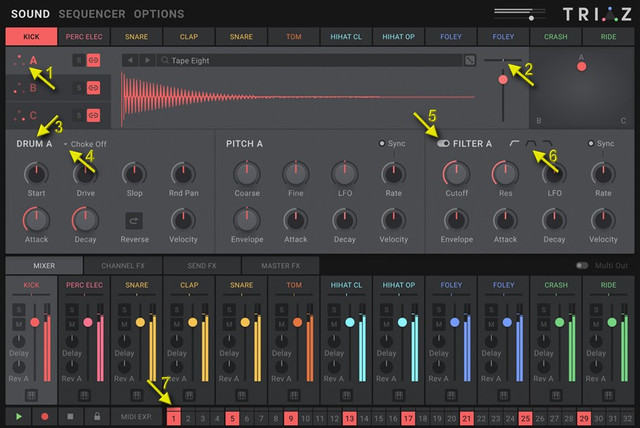
i.e. UI is flat, drab, grey, boring, and offers no affordances.... So you have to guess what is and isn't a button. 'Clean' as opposed to 'dirty'? Or 'clean' as in 'modern' and therefore 'good', even though it's worse than the user interfaces we've been using since the beginning of WIMP based operating systems, that had clearly visible 3D buttons, scrollbars, etc.?
In our opinion the TRIAZ interface is about as clean and as user friendly as can be (our opinion of course!). I'd love to see an example of what you feel to be a user friendly interface - feel free to share? I understand color choices themselves are totally personal preference though, but the dark look of TRIAZ is designed to make it easier on the eye - much more so than a UI like our Revolution instrument which is bright and more 'in your face' as such.

Thanks for your very polite and informative reply, if only other developers could respond so calmly without getting paranoid about their own designs.

Image
1) Can I click this? Is it a button or is it just INFORMATION?
2) Could you make the button any smaller? It's literally two by two pixels. Why? Because of 'flat design' - i.e. for no good reason whatsoever. What does this line actually represent? Balance? Space is not a problem nowadays for most users (I have a 4K 43" monitor), why not put an 'L' and 'R' on the scrollbar? Why not make the scrollbar slider much bigger, so you can more easily 'hit' it with your mouse pointer, or your finger, if you are using a touchscreen?
3) Is this the title of an area, or does it operate as a button? Since you don't have visible (i.e. 3D, skeuomorphic) buttons, you have to GUESS by pressing on every piece of text you can see. And all because of the stupidity of 'flat' design.
4) Is this tiny 'down arrow' (well, it's a triangle actually) supposed to inform me that there is a drop down menu? What was wrong with the old drop down menus, that were in clearly visible boxes, with much bigger down arrows? They weren't 'flat'. i.e. nothing was wrong with them, they were clear and they worked properly, and you could instantly see them.
5) Is this toggle switch 'on' or 'off' at the moment? If it was a skeuomorphic interface, it would look like a real toggle switch, and would light up when 'on'.
6) Are these buttons, or just representations of the current filter chosen? You have to click on them to FIND OUT. Which is why 'flat' design is rubbish.
7) The beat indicator (which I presume is what the top rectangle is) is designed in exactly the same way as the BUTTON below it. How much better it would look if the buttons were actually 3D buttons, and the indicators were glowing (when active) rectangles that actually looked like lights.

wave alchemy wrote: Fri Dec 24, 2021 7:02 pm Flat designs are much easier on the eye in general
I really don't understand what on Earth this is supposed to mean. "easier on the eye". So something that looks like a mockup that you make of the layout of a VST's controls BEFORE you actually spend months creating beautiful, skeuomorphic images that look like REAL buttons, knobs and controls, is somehow more attractive? WTF?
wave alchemy wrote: Fri Dec 24, 2021 7:02 pm . 3D or skeuomorphic designs (like we had in Revolution for example) look nice to look at, at a glance, but are not good for spending a lot of time creating with.
According to whom, and what research? Why did ALL software created from Windows 3.1 onwards use skeuomorphic buttons, scrollbars, drop down buttons, etc.? When they could have so easily not bothered and used crappy 'flat' design? Who was complaining back then that things needed 'flattening'? Nobody. Nobody at all.

wave alchemy wrote: Fri Dec 24, 2021 7:02 pm We've had no major complaints on the UX or design thus far. If anything the feedback has been more much positive towards the flat design. Again though, I understand this is personal preference and everyone has different thoughts on things!

Color is used in a minimal, thought out way throughout to differentiate sections and different drum types (i.e kick, snare etc), which makes sense from a UX point of view.
Nobody is objecting to the colours.
wave alchemy wrote: Fri Dec 24, 2021 7:02 pm There are barely any buttons in TRIAZ, and so many you are referring to a different UI?

Image
I can't tell what is and isn't a button, that's precisely my point.
Here are some decent interfaces, which don't require you to investigate the entire interface, in order to work out what is and isn't clickable. It's called AFFORDANCES. There was nothing wrong with skeuomorphic interfaces, they were perfect, and then some 'designers' came along and decided to change things, and gullible and stupid members of the public who thought they were being 'trendy' started saying how they liked 'flat' designs, and now we are faced with dreadful interfaces all over the place. Look at Kontakt's scrollbars - virtually impossible to use, because of MINIMALISM and 'flat' design. Look at Firefox - the scrollbar is light grey on a white background, almost impossible to see, even though it should be black on a white background, so that as soon as you flick your eyes to the right of the window to see where you are in the webpage, you can instantly see it, and click on it to move it.

Here are some good interfaces:

Image

Image

Image

There's no point in me making this post though, because the fools who pretend to 'like' interfaces that are pointlessly more difficult to use than skeuomorphic interfaces, will just carry on saying how 'clean' and 'contemporary' it is, all meaningless nonsense designed to impress other people.

Look at Windows 10 - you open a system window on a tablet and there is no CLOSE button visible - you have to manually swipe down from the top right corner of the screen in order to display the f***ing thing - unbelievably stupid, and very difficult to do on a 7" tablet, so why did they do it? Because some idiot 'designer' at Microsoft was paid to CHANGE things, so they did - and they made the interface much worse to use.

Look at Google Maps - they use virtually white lines for the borders of roads, on a WHITE background, so you cannot see the roads at all, just the road names. This insanity is everywhere.

Read this article by the Norman Nielsen Group, they do actual research trials into interfaces using large groups of people to test them:

https://www.nngroup.com/articles/flat-design/

And I quote:
"Your preferences and ability to interpret clickability signifiers aren’t the same as your users’ because you know what each element in your own design is intended to do."

When designing an interface, you should try to imagine what a complete newcomer to your interface will think when they see each element. Will they know what they can and cannot click? That is the FIRST thing you do when looking at any user interface - with skeuomorphic designs you can instantly see EVERY clickable element, with flat design you normally cannot.

Watch this video based on eye tracking, by the NN Group (if you can stand the hideous 'vocal fry' that is prevalent among American women nowadays... LOL):

https://www.nngroup.com/videos/flat-ui- ... confusion/

Unfortunately that video is about WEB design, as opposed to PROGRAM GUI design, which are two completely different things. When I see the letters 'UX' I want to throw up - first of all, 'experience' starts with an 'e', not an 'x', secondly, it almost always means somebody who doesn't know how to design an interface properly is going to create a flat and rubbish one, or ruin a perfectly good interface by changing it for no reason... usually by making it 'flat' and therefore far more difficult to use.

There are NO reasons for using 'flat' design. Interfaces are supposed to be USED by people, they are not there to stroke the so-called 'designers' ego (I say so-called because most designers are plagiarists, otherwise we wouldn't have crappy 'design trends', would we?)

Look at Windows 11, a prime example of what even the world's biggest software company (or is that Apple?) is producing, a load of rubbish which might as well be running on a monochrome monitor, no new interface elements (i.e. no new WAYS of doing things via the GUI, that actually make life easier for the user), and just watch the videos about the 'designers' of Windows 11's interface... it's laughable.

Post

BenfordLaw wrote: Fri Dec 31, 2021 12:53 pm
There's no point in me making this post though, because the fools who pretend to 'like' interfaces that are pointlessly more difficult to use than skeuomorphic interfaces, will just carry on saying how 'clean' and 'contemporary' it is, all meaningless nonsense designed to impress other people.
Well, I do like the design of the interface. I just don't get why they made it so small (it's even smaller than Drumvolution's interface). How can you even use it on your 43" monitor. But I guess it's designed for smaller laptop screens.

Anyway, I will probably still buy Triaz, as I'm kind of a WA completist (I bought every plugin they released). Triaz sounds fantastic.

Post

RichN wrote: Fri Dec 31, 2021 1:30 pm

Well, I do like the design of the interface. I just don't get why they made it so small (it's even smaller than Drumvolution's interface). How can you even use it on your 43" monitor. But I guess it's designed for smaller laptop screens.

Anyway, I will probably still buy Triaz, as I'm kind of a WA completist (I bought every plugin they released). Triaz sounds fantastic.
In terms of GUI size, we made this as big as possible whilst still allowing it to be fully visible (and not too large) on a laptop screen. We did the exact same thing with BASSYNTH too (identical in size), and Play Series products from NI I believe are also the exact same width for this reason. I remember with Drumvolution we had a rather substantial number of messages from Laptop users complaining the UI was too big! In short, we are just trying to keep everyone happy!

As I think I may have mentioned elsewhere, we are actively looking into options to move to a Native system in the future, and assuming TRIAZ is supported well enough by the community, this should hopefully be a reality in the not too distant future. Obviously if / when this happens, we would have scalable UI and other cool stuff..

And thanks for the kind words about the sound of TRIAZ. We invested a lot more time and money into the sounds in TRIAZ than any other product so far, and I'm glad this shows :D
http://www.wavealchemy.co.uk

Specializing in the development of forward-thinking virtual instruments and sample libraries.

Post

wave alchemy wrote: Fri Dec 31, 2021 11:38 am TRIAZ vs Drumvolution - Explained

Hey Guys,

So, we've had quite a few Drumvolution customers contact us recently - some seemingly confused as to the differences between TRIAZ and Drumvolution, and asking why TRIAZ is a new product and not an update. etc.
wave alchemy wrote: Fri Dec 31, 2021 11:38 am With TRIAZ we invested close to £100K on the sound design over a period spanning years. In addition to the instrument itself, you get access to all of the sound design and samples as WAV files, in well organized folders -to use in any DAW or software of your choice. Hopefully this one point alone shows you why we didn't simply update Drumvolution. Due to the vast effort in sound design and recording, it makes absolute sense to have TRIAZ as it's own unique product. Just like how for example Spitfire Audio has not one, but a variety of different sounding string libraries.
Could you provide also the Drumvolution samples in WAV format with TRIAZ?
That would make TRIAZ feel more like an update for existing Drumvolution customers. And paying for TRIAZ would then feel less painful.

Post Reply

Return to “Samplers, Sampling & Sample Libraries”