


You really do not have to include everything back to adam and eve in each reply, you know?
Just edit out everything but the last quote, that keeps the thread much more readable...
Thanks!
Tom
Bitwig 4.2 Beta Discussion
-

- KVRAF
- 6542 posts since 9 Dec, 2008 from Berlin
Last edited by ThomasHelzle on Thu Feb 17, 2022 8:48 pm, edited 1 time in total.
"Out beyond the ideas of wrongdoing and rightdoing, there is a field. I’ll meet you there." · Rumi
UrbanFlow.art · Instagram · YouTube
UrbanFlow.art · Instagram · YouTube
-
- KVRAF
- 5144 posts since 3 Oct, 2013
and a mono-sequencer with note based selector (8 rows 8 patterns)
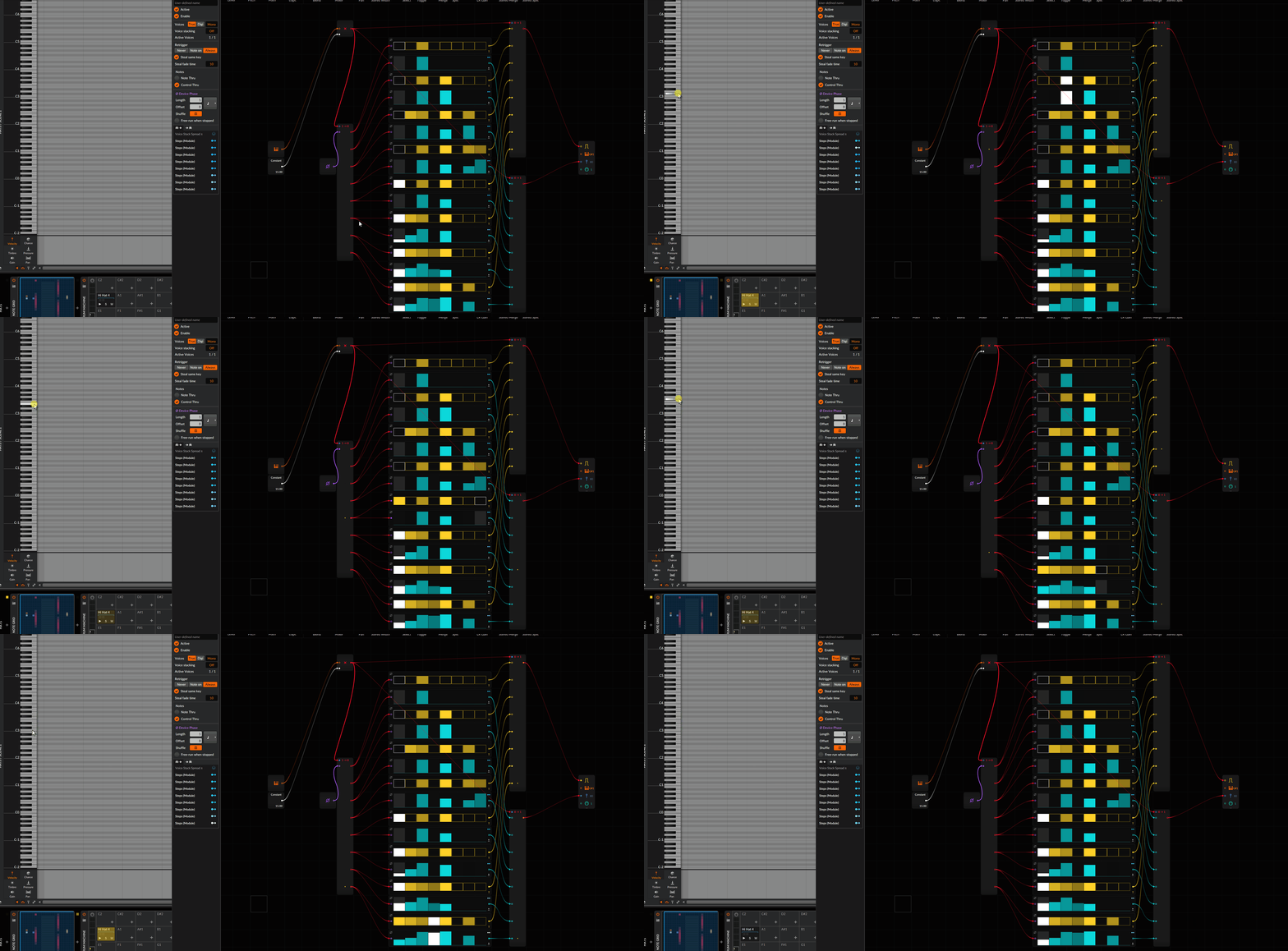
finally can create reusable drum patterns
ps. sure sure sharing it, needs some clicking ... selector is in C3-C4 range (out clicking stops it)
finally can create reusable drum patterns
ps. sure sure sharing it, needs some clicking ...
selector is in C3-C4 range (out clicking stops it)You do not have the required permissions to view the files attached to this post.
"Where we're workarounding, we don't NEED features." - powermat
-

- KVRian
- 1058 posts since 17 Jan, 2005 from London
Do you remember the good old days of NNTP Newsgroups and those absolute rotters who would insist on top-posting their replies? 

ThomasHelzle wrote: Thu Feb 17, 2022 6:27 pm You really do not have to include everything back to adam and eve in each reply, you know?
Just edit out everything but the last quote, that keeps the tread much more readable...
Bitwig 6.0.8 + Akai MIDIMix + Launchpad X + MF Twister
ExpressiveE Osmose Keyboard + Universal Audio Apollo Twin X
Mac Mini M1 16GB/4TB + macOS 26.5 Tahoe
ExpressiveE Osmose Keyboard + Universal Audio Apollo Twin X
Mac Mini M1 16GB/4TB + macOS 26.5 Tahoe
-
- KVRAF
- 5144 posts since 3 Oct, 2013
FL Studio Channel Rack like sequencer, proof of concept 3rows, rows can be triggered independently from each other
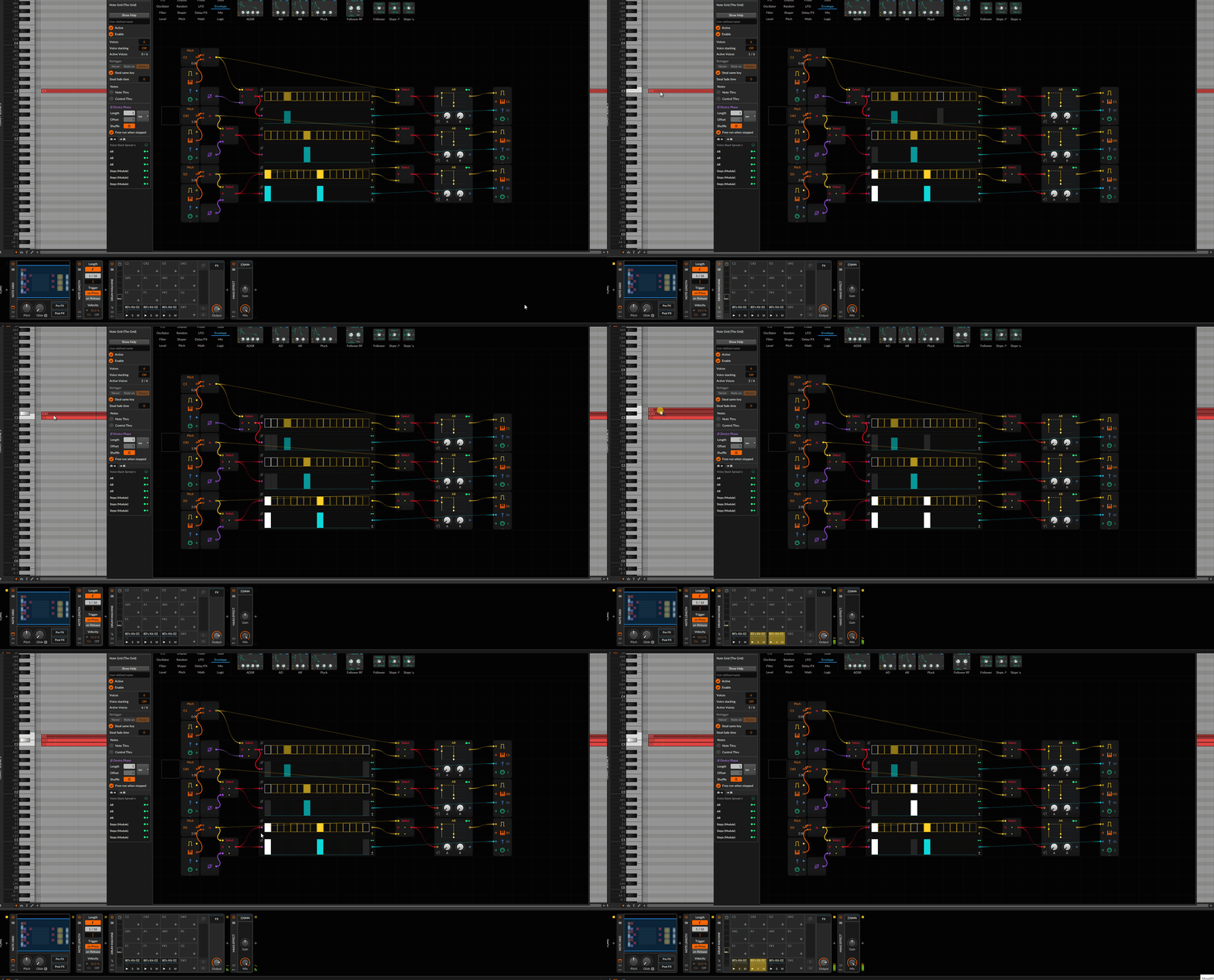
dunno what else is missing
ps. if you add more rows the poly number also should be raised
dunno what else is missing
ps. if you add more rows the poly number also should be raised
You do not have the required permissions to view the files attached to this post.
"Where we're workarounding, we don't NEED features." - powermat
-
- KVRAF
- 5144 posts since 3 Oct, 2013
^^^ so
sound everything nicely together (using sequencers above on all my drum tracks, with 15% shuffle), well played dear Bitwig developers

sound everything nicely together (using sequencers above on all my drum tracks, with 15% shuffle), well played dear Bitwig developers
"Where we're workarounding, we don't NEED features." - powermat
-

- KVRAF
- 26971 posts since 3 Feb, 2005 from in the wilds
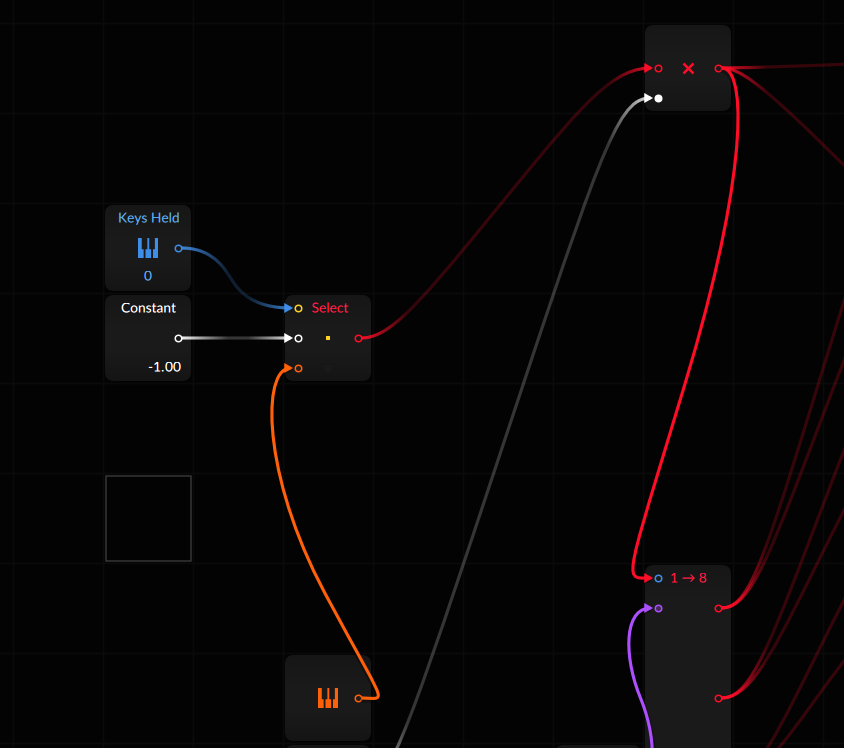
I suspect what you want to do can be done in the Note Grid. There is the Keys Held module which shows how many notes are in a chord.UncleAge wrote: Thu Feb 17, 2022 5:43 amYou get what i'm trying to say... For others tuning in keep in mind the video is basic. There are a few layers of things to add that would take things a few different directions. Like for instance, imagine a modulator in the Channel Filter that turns each channel on and off allowing for the bassline reacting to different channels. Just sayin...pdxindy wrote: Thu Feb 17, 2022 5:29 am...and you want the chord to 'start' at layer one each time regardless of how many notes and layers
-
- KVRAF
- 1783 posts since 11 Jun, 2005 from Phoenix, Arizona
Maybe. It may be possible to push all of the note data into an array, sort it and then push it out. Don't know yet. Should have a few hours to play with it later today.pdxindy wrote: Fri Feb 18, 2022 3:32 amI suspect what you want to do can be done in the Note Grid. There is the Keys Held module which shows how many notes are in a chord.
-
- KVRAF
- 6542 posts since 9 Dec, 2008 from Berlin
Otherwise it's always possible to request things during beta if you can make a god case.
I think sorting chords/notes makes a lot of sense.
Cheers,
Tom
I think sorting chords/notes makes a lot of sense.
Cheers,
Tom
Last edited by ThomasHelzle on Fri Feb 18, 2022 2:07 pm, edited 1 time in total.
"Out beyond the ideas of wrongdoing and rightdoing, there is a field. I’ll meet you there." · Rumi
UrbanFlow.art · Instagram · YouTube
UrbanFlow.art · Instagram · YouTube
-
- KVRian
- 911 posts since 10 Dec, 2013
Sorry for the huuuuuuge post but I've been experimenting with arpeggiation approaches this morning and came up with a proposal for 2 relatively simple modules that I think would drastically expand the potential of Note Grid.
Module: Polyphony ID
Provides a unique index for each active polyphony voice.
This module should ignore stack voices, as we already have stack voice modulators to handle that scenario. This voice counter purely reacts to the notes entering the Grid instance.
Inputs:
None
Outputs:
Polyphony Index - either normalised 0 to 1 value (based on current grid instance voice count), or integer counting from 0 upwards.
Parameters:
None
Module: Note Array
Stores a set of notes in a defined order and allows access to their parameters.
I also propose a note array module, relative of the existing array module. However, instead of writing values one at a time based on a write phase, a Write gate input would 'bang' the array to instantly populate it with all notes that are held at the point that the gate is received, in an order determined by customisable sorting logic (see 'Parameters' below). The module should look and feel very similar to the new Note In module, at least in terms of outputs - the only difference would be additional inspector parameters, and two inputs as defined below.
Inputs:
Write - gate input, instantly populates the array with all held notes at the point the gate arrives. Should have a pre-cord to Gate. May need some sort of tolerance setting to handle chords elegantly.
Read Phase/Index - same as existing array module. Allows us to pick which of the stored notes currently has its parameters addressable at the array outputs. Has the option to Normalize range, so expects either 0 to 1, or integers.
Outputs:
Same as Note In module, minus Gate (so Pitch, Velocity, Channel, Timbre, Pressure, Pan, Gain). Could be foldable like the Note In module for UI consistency. Pitch, Velocity and Channel should have editable default values like the Note In module, which would be used whenever a slot in the array is empty/upon initialisation.
Parameters:
These parameters should live in the inspector
Sort By - a dropdown list of different variables that we can use to sort the notes. I suggest Pitch, Velocity, Channel, Time. As uniqueness isn't guaranteed on one variable (e.g. you could have the same pitch playing on multiple channels), there should be a hidden sorting hierarchy which guarantees reproducible results. I think this hierarchy would be [Selected Parameter], Pitch, Channel?
Sort Pattern - we should be able to select from a list of different sorting patterns; these could possibly be borrowed from the arpeggiator options for consistency. The ones that are relevant are: Up, Down, Up + In, Down + In, Blossom Up, Blossom Down. This parameter should maybe be disabled/greyed out if Time is selected as the sorting variable, as I'm not sure it would really be useful.
Clear on Write - a tickbox to select whether or not the array should be cleared/reset whenever it is written to. Could be fun to switch this off, in which case small sets of input notes wouldn't fully overwrite old sets of notes, so you could get lingering notes from old chords etc.
Polyphony & array size considerations:
There would be some complexity in the interaction between the grid instance voice count and the functioning of the Note Array module. The 'external' polyphony logic (i.e. the logic that happens before a note enters the grid) discards oldest notes first once the voice limit is reached. Therefore if you had voice count set to e.g. 3, the Note Array would only be able to operate on/address the last 3 played notes. I think this is just something the user would have to be aware of, and if they want to operate on a subset of many played notes (e.g. extracting the highest 3 pitches from a very large chord), ensure that the voice count is set high enough not to be discarding 'old' notes that may still be of relevance to the sorting, then just take the first 3 notes from the array in their patch.
The array size should probably be fixed and equal to the voice count of the grid instance (ignoring stack voices).
Module: Polyphony ID
Provides a unique index for each active polyphony voice.
This module should ignore stack voices, as we already have stack voice modulators to handle that scenario. This voice counter purely reacts to the notes entering the Grid instance.
Inputs:
None
Outputs:
Polyphony Index - either normalised 0 to 1 value (based on current grid instance voice count), or integer counting from 0 upwards.
Parameters:
None
Module: Note Array
Stores a set of notes in a defined order and allows access to their parameters.
I also propose a note array module, relative of the existing array module. However, instead of writing values one at a time based on a write phase, a Write gate input would 'bang' the array to instantly populate it with all notes that are held at the point that the gate is received, in an order determined by customisable sorting logic (see 'Parameters' below). The module should look and feel very similar to the new Note In module, at least in terms of outputs - the only difference would be additional inspector parameters, and two inputs as defined below.
Inputs:
Write - gate input, instantly populates the array with all held notes at the point the gate arrives. Should have a pre-cord to Gate. May need some sort of tolerance setting to handle chords elegantly.
Read Phase/Index - same as existing array module. Allows us to pick which of the stored notes currently has its parameters addressable at the array outputs. Has the option to Normalize range, so expects either 0 to 1, or integers.
Outputs:
Same as Note In module, minus Gate (so Pitch, Velocity, Channel, Timbre, Pressure, Pan, Gain). Could be foldable like the Note In module for UI consistency. Pitch, Velocity and Channel should have editable default values like the Note In module, which would be used whenever a slot in the array is empty/upon initialisation.
Parameters:
These parameters should live in the inspector
Sort By - a dropdown list of different variables that we can use to sort the notes. I suggest Pitch, Velocity, Channel, Time. As uniqueness isn't guaranteed on one variable (e.g. you could have the same pitch playing on multiple channels), there should be a hidden sorting hierarchy which guarantees reproducible results. I think this hierarchy would be [Selected Parameter], Pitch, Channel?
Sort Pattern - we should be able to select from a list of different sorting patterns; these could possibly be borrowed from the arpeggiator options for consistency. The ones that are relevant are: Up, Down, Up + In, Down + In, Blossom Up, Blossom Down. This parameter should maybe be disabled/greyed out if Time is selected as the sorting variable, as I'm not sure it would really be useful.
Clear on Write - a tickbox to select whether or not the array should be cleared/reset whenever it is written to. Could be fun to switch this off, in which case small sets of input notes wouldn't fully overwrite old sets of notes, so you could get lingering notes from old chords etc.
Polyphony & array size considerations:
There would be some complexity in the interaction between the grid instance voice count and the functioning of the Note Array module. The 'external' polyphony logic (i.e. the logic that happens before a note enters the grid) discards oldest notes first once the voice limit is reached. Therefore if you had voice count set to e.g. 3, the Note Array would only be able to operate on/address the last 3 played notes. I think this is just something the user would have to be aware of, and if they want to operate on a subset of many played notes (e.g. extracting the highest 3 pitches from a very large chord), ensure that the voice count is set high enough not to be discarding 'old' notes that may still be of relevance to the sorting, then just take the first 3 notes from the array in their patch.
The array size should probably be fixed and equal to the voice count of the grid instance (ignoring stack voices).
Last edited by Hez on Fri Feb 18, 2022 2:43 pm, edited 2 times in total.
-
- KVRAF
- 1783 posts since 11 Jun, 2005 from Phoenix, Arizona
I agree with everything you laid outHez wrote: Fri Feb 18, 2022 1:58 pm<snip> a proposal for 2 relatively simple modules that I think would drastically expand the potential of Note Grid.<snip>
If you don't mind I will copy it (crediting you) in an email to Bitwig. The more people they hear from the better.
-
- KVRian
- 911 posts since 10 Dec, 2013
Please do! The more the merrierUncleAge wrote: Fri Feb 18, 2022 2:09 pm I agree with everything you laid out
If you don't mind I will copy it (crediting you) in an email to Bitwig. The more people they hear from the better.
I doubt we'll get any traction but it's always worth a try.-
- KVRian
- 798 posts since 5 Oct, 2020
does anyone know if it would be possible to make a random note sequencer constrained to a scale BUT where you can determine whether the pitch goes up or down with each step. Im trying this sort of stuff with note fx, you can do it with the arpeggiator + keyfilter if you feed it randomised chords with multi-note but you can only determine a few steps.
are there some arpeggiator vsts with more options for the note patterns eg up up down?
it also might work with random lfos on a note transposer + key filter, maybe if i randomly selected a random lfo, one with inverted modulation to make the pitch go down, but it would need to use a new transposer in a chain each time a note is pressed so it can transpose down from the last note rather than from the original note.
would it be possible in note grid? is there a vst for this?
edit: on second thought i think it would work with a pattern based arp like nora cm or phrasebox to determine the up up down pattern, after the random multi note and key filter. leaving this here in case anyone wants to try it/still interested if its possible with note fx or note grid
also to the people requesting msegs, you could use lfo tool or midishaper to send midi cc and use the midi cc modulator, but it would still be good to have a native device and grid module
are there some arpeggiator vsts with more options for the note patterns eg up up down?
it also might work with random lfos on a note transposer + key filter, maybe if i randomly selected a random lfo, one with inverted modulation to make the pitch go down, but it would need to use a new transposer in a chain each time a note is pressed so it can transpose down from the last note rather than from the original note.
would it be possible in note grid? is there a vst for this?
edit: on second thought i think it would work with a pattern based arp like nora cm or phrasebox to determine the up up down pattern, after the random multi note and key filter. leaving this here in case anyone wants to try it/still interested if its possible with note fx or note grid
also to the people requesting msegs, you could use lfo tool or midishaper to send midi cc and use the midi cc modulator, but it would still be good to have a native device and grid module
Last edited by j wazza on Fri Feb 18, 2022 8:25 pm, edited 1 time in total.
-
- KVRian
- 758 posts since 29 Jun, 2009
An additional way is to make a midi clip and use the operators to randomize the chance of the notes on your scale.
Make it as busy as you need.
Then use a Step modulator on the Note Transposer or, again, a Random one
Make it as busy as you need.
Then use a Step modulator on the Note Transposer or, again, a Random one
Reason - Reaktor