You calling my springs rusty bro?
Spring reverb: what is the state of affairs in 2023?
-
Funkybot's Evil Twin Funkybot's Evil Twin https://www.kvraudio.com/forum/memberlist.php?mode=viewprofile&u=116627
- KVRAF
- 12470 posts since 16 Aug, 2006
- addled muppet weed
- 111292 posts since 26 Jan, 2003 from through the looking glass
it adds grit.
- Beware the Quoth
- 35448 posts since 4 Sep, 2001 from R'lyeh Oceanic Amusement Park and Funfair
and colour.
An idiot on Set Theory:
"In some cases there is an object called red that contains everything that is red. In much the same way a pot is a plate."
-
Funkybot's Evil Twin Funkybot's Evil Twin https://www.kvraudio.com/forum/memberlist.php?mode=viewprofile&u=116627
- KVRAF
- 12470 posts since 16 Aug, 2006
-
- KVRAF
- 1655 posts since 3 Mar, 2009 from Colorado Springs
I'm gonna stick with real springs, Funky, convolution is close but there are crucial nonlinearities and of course each spring unit also just has its own sound. I am a great fan of algorithmic reverb for so many applications but springs are very hard to get right and to my ears there's more to go on getting it nailed. A well captured spring IR does sound pretty good to me, and in fact there are plenty of amps these days that have gone that route, eschewing real springs in favor of some built in convolution, but it falls apart if I put it next to a real tank, especially if the tank is on top of or mounted within the amp and speaker cab getting some resonance going on.
-
Funkybot's Evil Twin Funkybot's Evil Twin https://www.kvraudio.com/forum/memberlist.php?mode=viewprofile&u=116627
- KVRAF
- 12470 posts since 16 Aug, 2006
Well, yeah, if the choice is between real springs or convolution, I'll take real springs every time.
If the choice is modeled springs or convolution, well, I'm still going with good convolution-based reverbs (a la the Mixwave Benson).
- KVRist
- 161 posts since 31 Aug, 2020
Thank you, Jens for the informative responsejens wrote: Thu Oct 19, 2023 12:42 pmNexcellence doesn't emulate a normal spring reverb. The necklace type of spring reverb creates a much more naturally sounding reverberation due to its design.equisonus wrote: Thu Oct 19, 2023 10:18 am I’m at a crossroad looking to replace Twangström with one of two: PSP SpringBox or PSP Nexcellence. The latter is more flexible IMO.
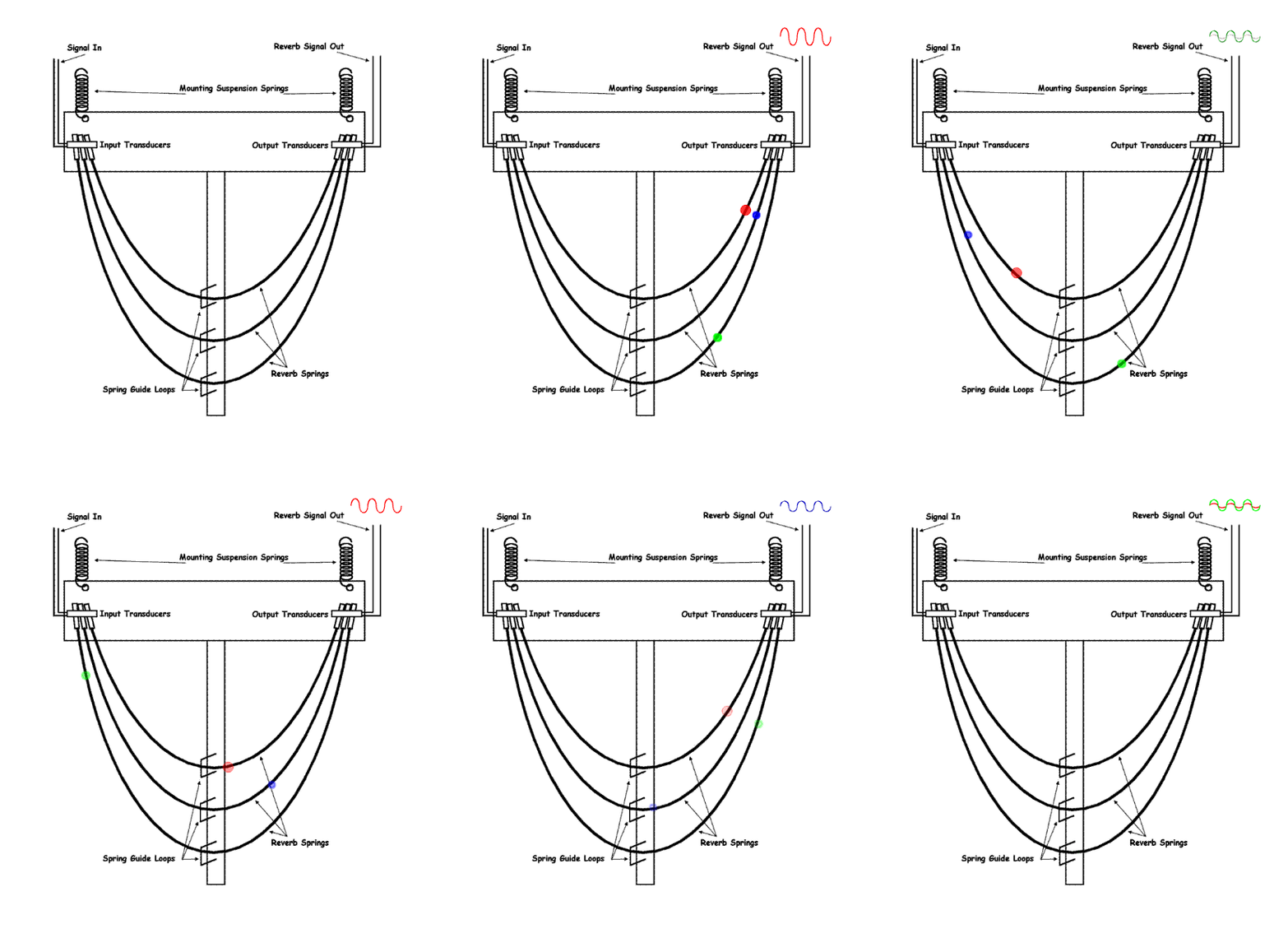
https://www.nshos.com/HAMMOND17.htmThis animated picture shows in simplified form how the necklace reverb unit works. The red, blue and green dots represent the vibrations in the three hanging springs that were induced there by the input transducers in response to the signal represented by the small sine wave that occurs briefly at the upper left. As you can see, the three signals from the springs arrive at different times at the output transducers. The springs, as expected, both slightly blur the initial attacks of subsequent signals as well as prolong them. Because the springs are wound from finer wire, and also because the transducers used have much less mass, these reverb units can respond adequately to the entire pitch range of a typical Hammond organ. Just as in a real room, the combination of reflected signals arriving at different times adds to the complexity of the final result, which sounds much more like real room reverb with repeats that occur randomly and are much less pronounced than those from a single spring reverb unit. Also, because the three springs have different lengths, they have different resonant frequencies from each other which makes the over-all response much flatter without pronounced peaks and cancellations that would occur with just a single spring
Monitors: HS7 / Mixing: Cubase Pro 13 / Mastering: WaveLab Pro 11.2 / Sound Design: Live 12 Suite
- KVRAF
- 7672 posts since 2 Sep, 2019
That’s a good idea. But when you do it, please do this:Funkybot's Evil Twin wrote: Thu Oct 19, 2023 1:58 pm Jens, one day I'll do a spring reverb blind shoot-out with some surf guitar using all the different spring plugins I own and I'll be sure to point you to thread so you rate your favorites.
1. Select an appropriate real amp and setup your ideal surf guitar tone using its spring reverb.
2. Capture this amp setup (sans reverb) with TONEX. Don’t move your mic when you’re done.
3. Record a surf guitar part into your DAW with a DI instrument input.
4. Reamp the part into your amp with the spring reverb turned back on and record it.
5. Match the sound of your recorded amp as closely as you can using the audio recorded in step 3, and the spring reverb plugins we’ve debated here (PSP, Arturia, Physical Audio, u-he, MixWave, etc) and any other spring reverb plugins/impulses that you want to test. Place these reverbs between two instances of TONEX loaded with your new Tone Model from step 2. The first TONEX should be amp only, with the cab disabled. The second one should be cab only, with the amp disabled. (You need to use the TONEX plugin for this, not TONEX in AT5.)
BONUS: create an impulse of the real spring reverb from your amp, and use it as one of the reverbs in step 5.
Make all of the recordings available for a shootout, including the miked amp with real spring from step 4.
THIS MUSIC HAS BEEN MIXED TO BE PLAYED LOUD SO TURN IT UP
-
- KVRist
- 189 posts since 7 Dec, 2004
Personally I've been really digging the Hornet SpringVerb.
I picked it up for free a few weeks back and it sounds really good to me !
I really like Softube's Spring Reverb too, but I find it just OK when I've tried to use it standalone.
Where the Softube one really shines is when I use it in Amp Room.
I stick it between the amp and the cabinet, so it runs through the speaker emulation.
It sounds a lot more realistic that way, at least to me.
Not that it is really "bad" on it's own per se, just a bit generic sounding to me.
Just my "tin eared" opinion though YMMV.
- Jay
I picked it up for free a few weeks back and it sounds really good to me !
I really like Softube's Spring Reverb too, but I find it just OK when I've tried to use it standalone.
Where the Softube one really shines is when I use it in Amp Room.
I stick it between the amp and the cabinet, so it runs through the speaker emulation.
It sounds a lot more realistic that way, at least to me.
Not that it is really "bad" on it's own per se, just a bit generic sounding to me.
Just my "tin eared" opinion though YMMV.
- Jay
- KVRAF
- 7672 posts since 2 Sep, 2019
Another model no one has talked about:
SKnote Necklace
The product page just says this:
And then there's also the REVERB ONLY setting in UAD Galaxy Tape Echo, which models the Roland RE-201 Space Echo's spring reverb.
It's pretty good for what it is. It's a lot different than a Type 4 spring tank found in a guitar amp. I think UAD's is better than Arturia's, either in Delay TAPE-201 or the Space Echo tank in REV SPRING-636 (which oddly sound quite different from each other.)
It would be interesting to compare Galaxy Tape Echo's spring directly to the spring reverb in the Space Echo models from Audiothing and GSi.
Keep in mind that UAD's Galaxy Tape Echo originally was called Roland RE-201 Space Echo, and was an official Roland approved model, before Roland started yanking all of their licensing agreements before launching Roland Cloud.
SKnote Necklace
The product page just says this:
https://www.sknoteaudio.com/wp/index.ph ... reo-sound/Necklace effect
Simply a spring reverb.
Physical modeling, non linear behaviour, multi-mode modulation.
Several springs, several combinations (parallel, series).
Round, nice reverb or “twisted” effects.
Tap on the springs to hear the impulse response and tune the reverb.
And then there's also the REVERB ONLY setting in UAD Galaxy Tape Echo, which models the Roland RE-201 Space Echo's spring reverb.
It's pretty good for what it is. It's a lot different than a Type 4 spring tank found in a guitar amp. I think UAD's is better than Arturia's, either in Delay TAPE-201 or the Space Echo tank in REV SPRING-636 (which oddly sound quite different from each other.)
It would be interesting to compare Galaxy Tape Echo's spring directly to the spring reverb in the Space Echo models from Audiothing and GSi.
Keep in mind that UAD's Galaxy Tape Echo originally was called Roland RE-201 Space Echo, and was an official Roland approved model, before Roland started yanking all of their licensing agreements before launching Roland Cloud.
THIS MUSIC HAS BEEN MIXED TO BE PLAYED LOUD SO TURN IT UP
-
Funkybot's Evil Twin Funkybot's Evil Twin https://www.kvraudio.com/forum/memberlist.php?mode=viewprofile&u=116627
- KVRAF
- 12470 posts since 16 Aug, 2006
I'll take that into consideration but I don't think it will be quite as scientific as you think. TONEX kind of "guesses" as to what it thinks is the cab+mic versus the amp it's not 100%. So putting the reverb "in the cab" by sandwiching two TONEX instances "should" work on paper, if TONEX was perfect at separating the cab from the amp, but in reality, I've done my own tests and know it wouldn't be exact.jamcat wrote: Thu Oct 19, 2023 6:31 pmThat’s a good idea. But when you do it, please do this:Funkybot's Evil Twin wrote: Thu Oct 19, 2023 1:58 pm Jens, one day I'll do a spring reverb blind shoot-out with some surf guitar using all the different spring plugins I own and I'll be sure to point you to thread so you rate your favorites.
1. Select an appropriate real amp and setup your ideal surf guitar tone using its spring reverb.
2. Capture this amp setup (sans reverb) with TONEX. Don’t move your mic when you’re done.
3. Record a surf guitar part into your DAW with a DI instrument input.
4. Reamp the part into your amp with the spring reverb turned back on and record it.
5. Match the sound of your recorded amp as closely as you can using the audio recorded in step 3, and the spring reverb plugins we’ve debated here (PSP, Arturia, Physical Audio, u-he, MixWave, etc) and any other spring reverb plugins/impulses that you want to test. Place these reverbs between two instances of TONEX loaded with your new Tone Model from step 2. The first TONEX should be amp only, with the cab disabled. The second one should be cab only, with the amp disabled. (You need to use the TONEX plugin for this, not TONEX in AT5.)
BONUS: create an impulse of the real spring reverb from your amp, and use it as one of the reverbs in step 5.
Make all of the recordings available for a shootout, including the miked amp with real spring from step 4.
Also, each individual spring tank I have has it's own sound. Same for the plugins. There's no "matching" the sounds because that doesn't work with two real spring tanks either.
I think the shoot-out (and that's what this would be: a shoot-out, not a "test") would go more something like this:
1. Here's an example of the real amp with the real spring (I could use the same audio and reamp for subsequent tests).
2. Here's an example of a TONEX capture of that amp with different plugin springs at settings I thought sounded good.
3. Here's the rendered audio of the playing+amp so you can run your own spring reverb plugins through
The goal would be to just simply listen and determine which plugins did you think sounded like "a real spring" and which did not. And the scope would be narrowly on trying to get a drippy, Type 4 (long tank, 2 spring) surf sound out of the plugins.
- KVRAF
- 7672 posts since 2 Sep, 2019
I am 99% certain this is how TONEX works at its most basic level:Funkybot's Evil Twin wrote: Fri Oct 20, 2023 2:26 pm TONEX kind of "guesses" as to what it thinks is the cab+mic versus the amp it's not 100%. So putting the reverb "in the cab" by sandwiching two TONEX instances "should" work on paper, if TONEX was perfect at separating the cab from the amp, but in reality, I've done my own tests and know it wouldn't be exact.
The machine learning algorithm adjusts weights on a tanh function to match the non-linear (distortion) components of the sound, and a convolution function to match the linear (tonal) components.
TONEX is then able to simply bypass the reconstruction of either of these separate processes. The tanh is the “amp” and the convolution is the “cab.”
If you want to be more accurate with separating the amp and cab, do 2 captures, one direct out from the amp with a load box, and one that bypasses the amp straight into the cab from a clean power amp. Tell TONEX both are amp+cab. This would also have the added benefit of capturing speaker distortion in the cab model, which convolution alone can’t do.
Sure, that’s understood. I’m just thinking about how we could best limit superfluous variables that could distract from hearing how each spring model works compared to a real spring, so we could hopefully determine which models get closest to the behaviors.Funkybot's Evil Twin wrote: Fri Oct 20, 2023 2:26 pm Also, each individual spring tank I have has it's own sound. Same for the plugins. There's no "matching" the sounds because that doesn't work with two real spring tanks either.
I think the shootout process you laid out is pretty much the same thing I was getting at.
THIS MUSIC HAS BEEN MIXED TO BE PLAYED LOUD SO TURN IT UP
- KVRist
- 230 posts since 22 Nov, 2002 from Manchester, UK
FYI, there's a SpaceXpander model in AudioThing's Springs. It's been my goto Dub spring for a while now. Chucking the AudioThing DubStation before it to use the 'FilterMan' Big Knob yields classic Tubby sounds.kidslow wrote: Mon Oct 16, 2023 5:38 pm
What I have read is Lee Perry used a Grampian 636 when he was recording at Black Ark. Not sure if he continued using one in the later recordings he did with On-U. Is Arturia the only 636 model plugin?
Fuse Audio has a free emulation of the Grampian 666, apparently made for the BBC Radiophonic workshop. Worth a download. Can get nasty. https://soundgas.com/resources/grampian ... -type-666/
King Tubby favored a Fisher SpaceXpander K-10, which has no emulation that I am aware of. When I get around to collecting hardware tanks, that would be where I start.
You do not have the required permissions to view the files attached to this post.
- KVRAF
- 1583 posts since 26 Aug, 2019
Thanks, I have Springs and missed that was added in an update. Will definitely have to play around with it. Unfortunately Dubstation has been discontinued.kevingham wrote: Fri Oct 20, 2023 8:12 pm FYI, there's a SpaceXpander model in AudioThing's Springs. It's been my goto Dub spring for a while now. Chucking the AudioThing DubStation before it to use the 'FilterMan' Big Knob yields classic Tubby sounds.
-
Funkybot's Evil Twin Funkybot's Evil Twin https://www.kvraudio.com/forum/memberlist.php?mode=viewprofile&u=116627
- KVRAF
- 12470 posts since 16 Aug, 2006
Sounds like they plan on replacing it with something. I'm sure Audio Thing will take care of existing owners. Plus, it still works and they just updated it so you'll be good using the current version for years.