

Evidence for my stance comes from trying the workflow and noticing that parametric rack EQs were an improvement over the integrated shelves. However, I claimed that part of the style is about the limitations such as limited channel counts and EQs. They force certain bussing decisions to be made.
Reason's mixers were also this type prior to the MClasses or the SSL.

Any way I can mimic a 90's effects rack?
-
- KVRian
- 1194 posts since 28 May, 2010 from Finland
-
- KVRian
- 1185 posts since 27 Apr, 2016
It's cool I am not trying to beat you up on this, enjoy it and have fun, but it's worth having a more accurate history 
"parametric rack EQs were an improvement over the integrated shelves"
I can tell you there were extremely few parametric rack EQ's used in home studios in the 90's. They were very costly items. TL Audio Ivory just made the back end of 90's. I think Blue face TL Audio were about then. You might of had a couple of options in a for hire SSL/Neve studio. Though any solid state 19 inch gear may not have been better than desk EQ. Unless it was something boutique.
Maybe a Tubetech for example:
http://www.tube-tech.com/the-lydkraft-story/
Parametric in a rack would not likely be put in place of a shelf eq. Different curves for different jobs they would not be swapped like for like, usually. Even lowly 8 bus desks had 2 semi parametric bands and 2 shelfs.
If we compare like for like, solid state EQ parametric bell bands may or may not have been better outside the desk EQ. Depending of course on the desk and its EQ and the specific 19 inch rack EQ in question. (An Amek 9098 maybe, though was predominantly a mic pre / DI with a decent EQ - it had switchable line input.)
"It leads to e.g. making tracks more polished earlier on and tuning them to frequencies that are suitable based on where the shelving bands are." But the shelving bands were likely 80/100Hz or 10/12kHz - so it makes no logical sense.
All sound engineers should understand to get the source right, but how do you do that with a digital synth in a home studio for example ? You cannot, you use the EQ you have, track key has nothing to do with it.
This is an incredibly broad topic that could extend to mastering as well.
The lions share of character is sound sources that position a sound in time. Sure, effects can be a part for this, the EQ can by and large be restricted / copied very easily. The EQ will be the least of concerns achieving character from the 90's.
For electronic music the synths, drum machines and samples with bandwidth restricted and lower bit depth verbs and delays used along with a lot of 80's hangover gear will form the large part of that sound. You can pop something like Tal DAC after your verb to 'lo fi' it. (31.25kHz SR rings a bell)
Many suggestions have been given and with a little care this should be fairly easy to achieve with a small amount of thought.
"parametric rack EQs were an improvement over the integrated shelves"
I can tell you there were extremely few parametric rack EQ's used in home studios in the 90's. They were very costly items. TL Audio Ivory just made the back end of 90's. I think Blue face TL Audio were about then. You might of had a couple of options in a for hire SSL/Neve studio. Though any solid state 19 inch gear may not have been better than desk EQ. Unless it was something boutique.
Maybe a Tubetech for example:
http://www.tube-tech.com/the-lydkraft-story/
Parametric in a rack would not likely be put in place of a shelf eq. Different curves for different jobs they would not be swapped like for like, usually. Even lowly 8 bus desks had 2 semi parametric bands and 2 shelfs.
If we compare like for like, solid state EQ parametric bell bands may or may not have been better outside the desk EQ. Depending of course on the desk and its EQ and the specific 19 inch rack EQ in question. (An Amek 9098 maybe, though was predominantly a mic pre / DI with a decent EQ - it had switchable line input.)
"It leads to e.g. making tracks more polished earlier on and tuning them to frequencies that are suitable based on where the shelving bands are." But the shelving bands were likely 80/100Hz or 10/12kHz - so it makes no logical sense.
All sound engineers should understand to get the source right, but how do you do that with a digital synth in a home studio for example ? You cannot, you use the EQ you have, track key has nothing to do with it.
This is an incredibly broad topic that could extend to mastering as well.
The lions share of character is sound sources that position a sound in time. Sure, effects can be a part for this, the EQ can by and large be restricted / copied very easily. The EQ will be the least of concerns achieving character from the 90's.
For electronic music the synths, drum machines and samples with bandwidth restricted and lower bit depth verbs and delays used along with a lot of 80's hangover gear will form the large part of that sound. You can pop something like Tal DAC after your verb to 'lo fi' it. (31.25kHz SR rings a bell)
Many suggestions have been given and with a little care this should be fairly easy to achieve with a small amount of thought.
-
- KVRian
- 1194 posts since 28 May, 2010 from Finland
??Synthman2000 wrote: Thu Mar 14, 2024 12:10 pm
All sound engineers should understand to get the source right, but how do you do that with a digital synth in a home studio for example ? You cannot, you use the EQ you have, track key has nothing to do with it.
Track key changes where your hihats and what not will be placed. Since the mix elements tend to appear at some sort of "harmonic intervals". So if your lead becomes lower, likely your hats come too, or you'd leave sonic gap between them.
With the shelving eq you don't have bands for mid-range. And to tune bass and treble, your bass and treble better reside in sweet spots.
-
- KVRian
- 1185 posts since 27 Apr, 2016
I will leave you in your fantasy.
-
- KVRian
- 1194 posts since 28 May, 2010 from Finland
In essence the shelving EQs are about "add/reduce brightness" or "add/reduce oomph".
They do have the property though that when your mix is "nicely layered", then you can sort of mix by making deeper cuts at some tracks and less deep on some other ones and the shelf "curve" sort of layers the overtones of the individual tracks together. Like this:
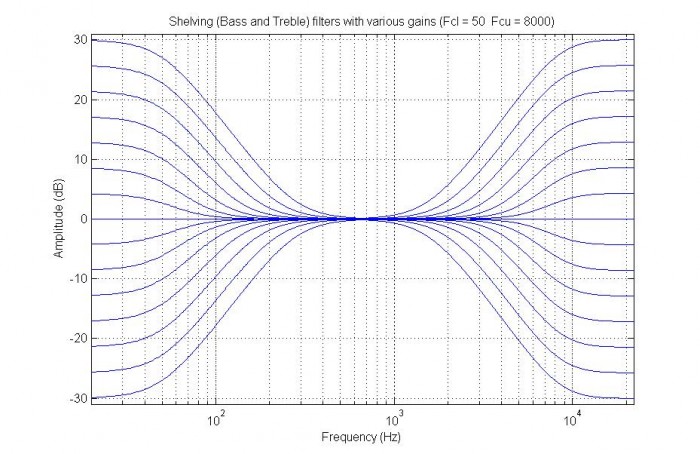
^ This is a property of such EQs. An example where it would show is with your 808-style bass and a common synth bass around the same frequencies. Or "sparkling juno pads" and 808 hi-hats (both closed and open) + ride.
This is not about this genre, but a pro mixer once said that a good mix only takes two shelving EQs at the master to finish. At the channel or the master you're not supposed to be dealing with tonal problems, but just how much bass or how much treble you want overall. Having to use one small parametric dip somewhere is a rare case, if your inputs are all solid as they should be. That's why there are those tilt EQ plug-ins too.
In Reason's 14:2 the bands are placed at 80Hz and 12kHz and they give +-24dB of gain. However, this does make a difference. The slope cannot be straight from that point, so the "Q" is wider like in https://rangeofsounds.com/wp-content/up ... ith-EQ.png.
They do have the property though that when your mix is "nicely layered", then you can sort of mix by making deeper cuts at some tracks and less deep on some other ones and the shelf "curve" sort of layers the overtones of the individual tracks together. Like this:
^ This is a property of such EQs. An example where it would show is with your 808-style bass and a common synth bass around the same frequencies. Or "sparkling juno pads" and 808 hi-hats (both closed and open) + ride.
This is not about this genre, but a pro mixer once said that a good mix only takes two shelving EQs at the master to finish. At the channel or the master you're not supposed to be dealing with tonal problems, but just how much bass or how much treble you want overall. Having to use one small parametric dip somewhere is a rare case, if your inputs are all solid as they should be. That's why there are those tilt EQ plug-ins too.
In Reason's 14:2 the bands are placed at 80Hz and 12kHz and they give +-24dB of gain. However, this does make a difference. The slope cannot be straight from that point, so the "Q" is wider like in https://rangeofsounds.com/wp-content/up ... ith-EQ.png.
-

- KVRAF
- 20798 posts since 22 Nov, 2000 from Southern California
Crystal Method’s first album was done on a pair of CR-1604’s. Kool Keith rapped about a Mackie and I assume that means Dan the Automator had one at The Glue Factory, meaning that’s what their albums and DJ Shadow’s were mixed on. Andy Barlow used a Mackie 32:8. Orbital used a Mackie 24:8.
That said, everyone was using the filters in our samplers more than EQ’s.
That said, everyone was using the filters in our samplers more than EQ’s.
-
- KVRian
- 1194 posts since 28 May, 2010 from Finland
Different genres would have different conventions, but I assumed that the main issue with the lack of EQs is sample-based music. Such as a lot of drum & bass and jungle or e.g. hiphop. So if you put in sampled hi-hats and female vocals, then you'd be in problems with the EQs, unless you alter the pitches so that they layer nicely. You cannot use LPF/HPF, because that'd eat all the overtones/undertones. Pure synth music does not often need EQ at all, because most often all the sounds are quite clear.Uncle E wrote: Thu Mar 14, 2024 2:25 pm Crystal Method’s first album was done on a pair of CR-1604’s. Kool Keith rapped about a Mackie and I assume that means Dan the Automator had one at The Glue Factory, meaning that’s what their albums and DJ Shadow’s were mixed on. Andy Barlow used a Mackie 32:8. Orbital used a Mackie 24:8.
That said, everyone was using the filters in our samplers more than EQ’s.
-
- KVRian
- 1194 posts since 28 May, 2010 from Finland
I also propose that the EQs in the mixers has more to do with the sound than, contrary to what many people think, the DACs in samplers. So a lot of people think that they need an authentic S-950 or SP-1200 or some Ensoniq in order to have their samples sound authentic.
-
- KVRAF
- 20798 posts since 22 Nov, 2000 from Southern California
It goes without saying that the subject is too broad to generalize. But you can hear the sound of the samplers with many artists:
MPC60: DJ Shadow
MPC3000: Dr. Dre
e6400: Lamb
S1000: Leftfield
S950: 4Hero
S760: Roni Size
W30: The Prodigy
MPC60: DJ Shadow
MPC3000: Dr. Dre
e6400: Lamb
S1000: Leftfield
S950: 4Hero
S760: Roni Size
W30: The Prodigy
-
- KVRian
- 1185 posts since 27 Apr, 2016
"but a pro mixer once said that a good mix only takes two shelving EQs at the master to finish."
Some mix engineers attend one too many "Cider retreats/ceremonies"
The better a mix is generally the less a mastering engineer has to do. Mastering has evolved over the years to be something different that transferring audio between formats
A good mastering engineer wears a few different hats in 2024.
Some mix engineers attend one too many "Cider retreats/ceremonies"
The better a mix is generally the less a mastering engineer has to do. Mastering has evolved over the years to be something different that transferring audio between formats
A good mastering engineer wears a few different hats in 2024.
Last edited by Synthman2000 on Thu Mar 14, 2024 5:06 pm, edited 1 time in total.
-
Funkybot's Evil Twin Funkybot's Evil Twin https://www.kvraudio.com/forum/memberlist.php?mode=viewprofile&u=116627
- KVRAF
- 12482 posts since 16 Aug, 2006
The funny thing about conversations like these are that these guys were just using the technology available to them and getting on and making music with it. Even if they were trying to kind of mimic someone else's sound, the gear they had was so limited that they'd end up coming up with their own version of it and just moving on.
I generally think forum posters, myself included, are a bit too spoiled for choice and get too bogged down in the details; having more of an "engineering brain" than an "artists brain" (not that you can't do both). But if someone reading this has really got music to make, best thing would be not to worry about mimicing the sound of 90's FX racks and samplers, and just finish the song. Maybe you'll develop a sound people will be trying to mimic 30 years from now. The things we're connecting with though, are not the actual sounds of the 90's, but the time, the place, people, the youth, and most importantly the songs.
I generally think forum posters, myself included, are a bit too spoiled for choice and get too bogged down in the details; having more of an "engineering brain" than an "artists brain" (not that you can't do both). But if someone reading this has really got music to make, best thing would be not to worry about mimicing the sound of 90's FX racks and samplers, and just finish the song. Maybe you'll develop a sound people will be trying to mimic 30 years from now. The things we're connecting with though, are not the actual sounds of the 90's, but the time, the place, people, the youth, and most importantly the songs.
-
- KVRian
- 1185 posts since 27 Apr, 2016
Nah.. why not enjoy researching what people did and recreating it, there is nothing wrong with it at all.
Finishing tracks should be a given for those who want to really. To produce modern dance genre mixes that go extremely loud like the biggest artists of any genre is a lot of painstaking work. It is not very enjoyable and it does not make your music any better. It can be important for some people, sometimes.
You need a bit of everything, ideas, work ethic, engineering knowledge, a production vision.
You have to come to your own conclusions about what you are doing in the end and draw on good resources to make those decisions. Not all will get where they want to be on any given aspect of audio production.. what can you do, it is what it is.
Some people are all send no receive and do not discriminate on what they do absorb.
Some people even make presets for audio processing, their endeavour is about as useful a Mercedes indicator lamp installers.
Cannot worry about everything in life, it will send you to an early grave.
Finishing tracks should be a given for those who want to really. To produce modern dance genre mixes that go extremely loud like the biggest artists of any genre is a lot of painstaking work. It is not very enjoyable and it does not make your music any better. It can be important for some people, sometimes.
You need a bit of everything, ideas, work ethic, engineering knowledge, a production vision.
You have to come to your own conclusions about what you are doing in the end and draw on good resources to make those decisions. Not all will get where they want to be on any given aspect of audio production.. what can you do, it is what it is.
Some people are all send no receive and do not discriminate on what they do absorb.
Some people even make presets for audio processing, their endeavour is about as useful a Mercedes indicator lamp installers.
Cannot worry about everything in life, it will send you to an early grave.
Last edited by Synthman2000 on Thu Mar 14, 2024 5:20 pm, edited 2 times in total.
-
- KVRian
- 1194 posts since 28 May, 2010 from Finland
I think the issue is that millenials in particular have grown into the unlimited toolset world, and they must be explained why limitations can be a good thing. Because limitations are about a choice now, not "the only thing you have". All of the contemporary producers start with the ability to put, say, 20 EQs on a channel if they want. And they can buy a plug-in for $59 that is higher quality than some high-end device in the 90s. But they need to be explained, why 0 EQs and your DAW's stock reverb can be enough. Or why they don't need the latest and greatest for great music.Funkybot's Evil Twin wrote: Thu Mar 14, 2024 5:02 pm The funny thing about conversations like these are that these guys were just using the technology available to them and getting on and making music with it. Even if they were trying to kind of mimic someone else's sound, the gear they had was so limited that they'd end up coming up with their own version of it and just moving on.
I generally think forum posters, myself included, are a bit too spoiled for choice and get too bogged down in the details; having more of an "engineering brain" than an "artists brain" (not that you can't do both). But if someone reading this has really got music to make, best thing would be not to worry about mimicing the sound of 90's FX racks and samplers, and just finish the song. Maybe you'll develop a sound people will be trying to mimic 30 years from now. The things we're connecting with though, are not the actual sounds of the 90's, but the time, the place, people, the youth, and most importantly the songs.
-
- KVRAF
- 20798 posts since 22 Nov, 2000 from Southern California
Exactly. We depended on samplers because we didn't have any other choice. Couldn't just open a project and have all our synth patches and EQ's instantly ready to go. A sampler was the next best thing.Funkybot's Evil Twin wrote: Thu Mar 14, 2024 5:02 pm The funny thing about conversations like these are that these guys were just using the technology available to them and getting on and making music with it. Even if they were trying to kind of mimic someone else's sound, the gear they had was so limited that they'd end up coming up with their own version of it and just moving on.
I was there and am not nostalgic about it at all.
-
- KVRian
- 1185 posts since 27 Apr, 2016
Unlimited tool set, very much limited in practical knowledge, in fundamental knowledge. That is a statement of fact not a judgement. And then the expectation is that it should be easy on top of that.soundmodel wrote: Thu Mar 14, 2024 5:18 pmI think the issue is that millenials in particular have grown into the unlimited toolset world, and they must be explained why limitations can be a good thing. Because limitations are about a choice now, not "the only thing you have". All of the contemporary producers start with the ability to put, say, 20 EQs on a channel if they want. And they can buy a plug-in for $59 that is higher quality than some high-end device in the 90s. But they need to be explained, why 0 EQs and your DAW's stock reverb can be enough. Or why they don't need the latest and greatest for great music.Funkybot's Evil Twin wrote: Thu Mar 14, 2024 5:02 pm The funny thing about conversations like these are that these guys were just using the technology available to them and getting on and making music with it. Even if they were trying to kind of mimic someone else's sound, the gear they had was so limited that they'd end up coming up with their own version of it and just moving on.
I generally think forum posters, myself included, are a bit too spoiled for choice and get too bogged down in the details; having more of an "engineering brain" than an "artists brain" (not that you can't do both). But if someone reading this has really got music to make, best thing would be not to worry about mimicing the sound of 90's FX racks and samplers, and just finish the song. Maybe you'll develop a sound people will be trying to mimic 30 years from now. The things we're connecting with though, are not the actual sounds of the 90's, but the time, the place, people, the youth, and most importantly the songs.
Some so called engineers have exhibited clear lack of basic theoretical and practical knowledge where it actually counts. Shame really that gets hoovered up and repeated.
Democratization of tools and digital capability did not grow equally in tandem with professional training, experience, personal fortitude, reduced attention span like a disease. You need to tough it out, getting things wrong, picking yourself up, reflecting and getting better.
And to top it all off now the expectation is that soon AI will do it all for you.
Good luck, you'll be needing it.