

I believe the Intellijel Dixie reverses direction instead of resetting to zero on a sync pulse but it's quite early in the morning and i need to go so i don't have time to look it up just now.
EDIT: Found it.
How analog oscillators work
-

- KVRAF
- Topic Starter
- 9590 posts since 17 Sep, 2002 from Gothenburg Sweden
-

- KVRAF
- 12615 posts since 7 Dec, 2004
yep that's a completely different effect that changes the timbre even more. it doesn't even sound much like sync anymore.
there are a few other classes of sync as well, i think five in total. i'd have to think too hard to remember what the other two are.
there are a few other classes of sync as well, i think five in total. i'd have to think too hard to remember what the other two are.
Free plug-ins for Windows, MacOS and Linux. Xhip Synthesizer v8.0 and Xhip Effects Bundle v6.7.
The coder's credo: We believe our work is neither clever nor difficult; it is done because we thought it would be easy.
Work less; get more done.
The coder's credo: We believe our work is neither clever nor difficult; it is done because we thought it would be easy.
Work less; get more done.
-
- KVRAF
- Topic Starter
- 9590 posts since 17 Sep, 2002 from Gothenburg Sweden
Yeah i do have a slight problem with that effect being called sync as it doesn't really sound like it nor is it the same thing as sync. But most people call it sync so what can you do ?aciddose wrote:yep that's a completely different effect that changes the timbre even more. it doesn't even sound much like sync anymore.

I found 4 a while back when i thought i'd learn sync once and for all. Saw/Tri core Hard/Soft sync but i was even more confused after i read up on it than i was before.aciddose wrote: there are a few other classes of sync as well, i think five in total. i'd have to think too hard to remember what the other two are.
-

- Beware the Quoth
- 35433 posts since 4 Sep, 2001 from R'lyeh Oceanic Amusement Park and Funfair
And the CEM3340 rears its head again:jupiter8 wrote:Yeah i do have a slight problem with that effect being called sync as it doesn't really sound like it nor is it the same thing as sync. But most people call it sync so what can you do ?aciddose wrote:yep that's a completely different effect that changes the timbre even more. it doesn't even sound much like sync anymore.I found 4 a while back when i thought i'd learn sync once and for all. Saw/Tri core Hard/Soft sync but i was even more confused after i read up on it than i was before.aciddose wrote: there are a few other classes of sync as well, i think five in total. i'd have to think too hard to remember what the other two are.
"And to make matters even more confusing; the CEM3340 can do two types of hard sync, depending on whether it is synced by positive or negative pulses... and it's a different hardsync than the one described above (in fact, it's more like the case 1 soft sync...) "
http://electro-music.com/forum/post-175831.html#175831
An idiot on Set Theory:
"In some cases there is an object called red that contains everything that is red. In much the same way a pot is a plate."
"In some cases there is an object called red that contains everything that is red. In much the same way a pot is a plate."
-

- KVRAF
- 14123 posts since 20 Nov, 2003 from Lost and Spaced
This is from Wiki:
VCOs can be generally categorized into two groups based on the type of waveform produced: 1) harmonic oscillators, and 2) relaxation oscillators.
Harmonic oscillators generate a sinusoidal waveform. They consist of an amplifier that provides adequate gain and a resonant circuit that feeds back signal to the input. Oscillation occurs at the resonant frequency where a positive gain arises around the loop. Some examples of harmonic oscillators are crystal oscillators and LC-tank oscillators. When part of the resonant circuit's capacitance is provided by a varactor diode, the voltage applied to that diode varies the frequency.
Relaxation oscillators can generate a sawtooth or triangular waveform. They are commonly used in monolithic integrated circuits (ICs). They can provide a wide range of operational frequencies with a minimal number of external components. Relaxation oscillator VCOs can have three topologies: 1) grounded-capacitor VCOs, 2) emitter-coupled VCOs, and 3) delay-based ring VCOs. The first two of these types operate similarly. The amount of time in each state depends on the time for a current to charge or discharge a capacitor. The delay-based ring VCO operates somewhat differently however. For this type, the gain stages are connected in a ring. The output frequency is then a function of the delay in each of stages.
VCOs can be generally categorized into two groups based on the type of waveform produced: 1) harmonic oscillators, and 2) relaxation oscillators.
Harmonic oscillators generate a sinusoidal waveform. They consist of an amplifier that provides adequate gain and a resonant circuit that feeds back signal to the input. Oscillation occurs at the resonant frequency where a positive gain arises around the loop. Some examples of harmonic oscillators are crystal oscillators and LC-tank oscillators. When part of the resonant circuit's capacitance is provided by a varactor diode, the voltage applied to that diode varies the frequency.
Relaxation oscillators can generate a sawtooth or triangular waveform. They are commonly used in monolithic integrated circuits (ICs). They can provide a wide range of operational frequencies with a minimal number of external components. Relaxation oscillator VCOs can have three topologies: 1) grounded-capacitor VCOs, 2) emitter-coupled VCOs, and 3) delay-based ring VCOs. The first two of these types operate similarly. The amount of time in each state depends on the time for a current to charge or discharge a capacitor. The delay-based ring VCO operates somewhat differently however. For this type, the gain stages are connected in a ring. The output frequency is then a function of the delay in each of stages.
-

- KVRAF
- 13124 posts since 7 May, 2006 from Southern California
Doepfer's new Quad VCLFO has all sorts of sync goin' on...
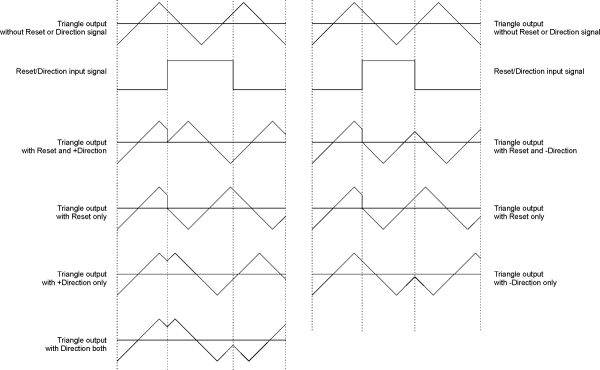
http://www.doepfer.de/a1434.htm
These are Triangle-core oscillators that can do a few combinations of hard sync and reversing sync. I haven't heard them yet myself, but generally, I prefer the resetting type of sync to reversing sync.
http://www.doepfer.de/a1434.htm
These are Triangle-core oscillators that can do a few combinations of hard sync and reversing sync. I haven't heard them yet myself, but generally, I prefer the resetting type of sync to reversing sync.