


Vojtech, I am lost. Do you have a document about all these numbers that characterize a filter?
Specifically I am just fiddling with MBandpass (which has some misleading name, its a powerful double multimode filter if you ask me!)
I selected LP24. Now, all my life I have been thinking that this characterizes the filter completely. 24 is the order, others say 4 pole, and this describes the bandwith, or Q, which is another way of defining the bandwidth. However, you can configure that Q *in addition* to selecting the order. I am puzzled. Obviously all my filter knowledge is wrong. (Which does not surprise me, the math behind audio always defeated me in no time).
Can you please clarify for a dummy user? What is the order, that is Q?
I looked through your tutorials, but nothing seems appropriate judging from the names.
Thanks a lot!
Filters -> poles, order, Q, slope, bandwidth, WTF?
-

- KVRAF
- 1758 posts since 15 Mar, 2013 from Germany
-
- KVRAF
- 1800 posts since 10 Feb, 2007
I googled for 'audio filters explained' and found this:
-
- KVRAF
- Topic Starter
- 1758 posts since 15 Mar, 2013 from Germany
Q not explained in the video or did I miss it?
-
- KVRAF
- 1800 posts since 10 Feb, 2007
http://www.rane.com/note170.html
http://en.wikipedia.org/wiki/Audio_filter
In layman's terms; Q (quality) is how narrow or wide the peak of the resonance is.
The higher the number, the smaller the peak. A Q of 3 is much more narrow than a Q of 0.5
http://en.wikipedia.org/wiki/Audio_filter
In layman's terms; Q (quality) is how narrow or wide the peak of the resonance is.
The higher the number, the smaller the peak. A Q of 3 is much more narrow than a Q of 0.5
-
- KVRAF
- Topic Starter
- 1758 posts since 15 Mar, 2013 from Germany
Sorry man your links are not helping me. I need an explanation what is slope/order and Q for a LPF. Preferably with some illustration.
-
- KVRer
- 13 posts since 23 Dec, 2009 from Netherlands
Maybe you should download the A-108 module document from the Doepfer site. http://www.doepfer.de/home_e.htm - choose module overview. Hope this helps.
-

- Banned
- 10196 posts since 12 Mar, 2012 from the Bavarian Alps to my feet and the globe around my head
"Order" is the same as "pole" ("First Order" = "1 Pole")...
For your example: 24 db is the slope steepness: 24 db/Oct = 4 pole = 4th order
Q is *NOT* the band width; Q is the "resonance", here you see the influence of Q on the filter:

For your example: 24 db is the slope steepness: 24 db/Oct = 4 pole = 4th order
Q is *NOT* the band width; Q is the "resonance", here you see the influence of Q on the filter:
-
- KVRAF
- 4908 posts since 10 Aug, 2004 from Colorado Springs
Q IS the bandwidth of a parametric band pass or band reject filter.
To calculate Q of a band reject filter, divide the center frequency of the filter by the width; with width defined by the points to the right and left of the center frequency where the filter amplitude is -3 dB from unity gain.
For a band pass filter, same thing except for the width being the + 3dB points.
Wikipedia article: http://en.wikipedia.org/wiki/Q_factor
Perhaps Tricky-loops definition applies to HP or LP filters only, not sure - but the Q I describe above has been used for decades to describe filter width as a function of frequency.
To calculate Q of a band reject filter, divide the center frequency of the filter by the width; with width defined by the points to the right and left of the center frequency where the filter amplitude is -3 dB from unity gain.
For a band pass filter, same thing except for the width being the + 3dB points.
Wikipedia article: http://en.wikipedia.org/wiki/Q_factor
Perhaps Tricky-loops definition applies to HP or LP filters only, not sure - but the Q I describe above has been used for decades to describe filter width as a function of frequency.

-
- Banned
- 10196 posts since 12 Mar, 2012 from the Bavarian Alps to my feet and the globe around my head
For a REAL band pass filter or band reject (notch) filter "Q" can be used instead of the band width, of course.rockstar_not wrote:Q IS the bandwidth of a parametric band pass or band reject filter.
To calculate Q of a band reject filter, divide the center frequency of the filter by the width; with width defined by the points to the right and left of the center frequency where the filter amplitude is -3 dB from unity gain.
For a band pass filter, same thing except for the width being the + 3dB points.
Wikipedia article: http://en.wikipedia.org/wiki/Q_factor
Perhaps Tricky-loops definition applies to HP or LP filters only, not sure - but the Q I describe above has been used for decades to describe filter width as a function of frequency.
But in case of the MBandpass it obviously labels the resonance, not the band width.
The name "MBandpass" is confusing, anyway, as it's not a simple band pass filter but a combination of lowpass and highpass filter (which in effect *IS* some kind of band pass filter).
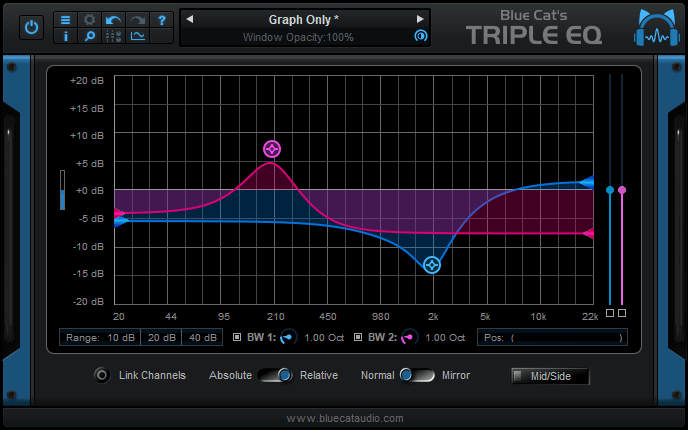
I have even seen peak & notch filters with "band width" controllers instead of "Q", so that's a bit confusing. Here's an example ("band width" instead of "Q"):
Last edited by Tricky-Loops on Fri Aug 09, 2013 4:42 am, edited 1 time in total.
-
- Banned
- 10196 posts since 12 Mar, 2012 from the Bavarian Alps to my feet and the globe around my head
For our mathematicians (there's even a German translation): 
http://www.sengpielaudio.com/calculator-bandwidth.htm
http://www.sengpielaudio.com/calculator-bandwidth.htm
-
- KVRAF
- Topic Starter
- 1758 posts since 15 Mar, 2013 from Germany
OK so there seems to be some inconsistency about the usage of the term Q, it seems to be different in case of LP/HP vs BP.
But your picture of Q = resonance in case of LP makes sense, Tricky.
But your picture of Q = resonance in case of LP makes sense, Tricky.
-
- KVRAF
- Topic Starter
- 1758 posts since 15 Mar, 2013 from Germany
Maybe Vojtech can still say something "official" on this?
-
 MeldaProduction MeldaProduction https://www.kvraudio.com/forum/memberlist.php?mode=viewprofile&u=176122
 - KVRAF
- 14325 posts since 15 Mar, 2008 from Czech republic
Hmmm, I think all was explained here. Usually Q = bandwidth = resonance, just expressed differently. I suggest checking MDynamicEq (or MAutoDynamicEq), set a band to LP or HP, then it has both order and Q parameters, so you can see what they do.

-
- KVRAF
- Topic Starter
- 1758 posts since 15 Mar, 2013 from Germany
That is a good idea I will do that.
Its just a little against my intuitive understanding, I learned that resonance is sort of the height of the bump at cutoff while bandwith is how steep the rolloff is.
Its just a little against my intuitive understanding, I learned that resonance is sort of the height of the bump at cutoff while bandwith is how steep the rolloff is.
-
MeldaProduction MeldaProduction https://www.kvraudio.com/forum/memberlist.php?mode=viewprofile&u=176122
- KVRAF
- 14325 posts since 15 Mar, 2008 from Czech republic
No no, bandwidth is basically the same thing. But note that these terms are for engineers (creators of the filters). Q is generally used for target users. Generally high Q -> low bandwidth and the filter design is based on resonance, so higher Q (also called quality) produces more resonance, because that's the only way the filter could satisfy the "low bandwidth" requirement, speaking of normal language, a little normal at leastUser123 123123 wrote:That is a good idea I will do that.
Its just a little against my intuitive understanding, I learned that resonance is sort of the height of the bump at cutoff while bandwith is how steep the rolloff is.
 .
.