


Question about FM in Diva/FM in general
-
- KVRian
- 567 posts since 21 May, 2016
So my understanding of frequency modulation in the digital domain is that it's actually phase modulation where the carrier is modulated according changes in slope of the modulator, which is why square waves do basically nothing as modulators, right? Yet in Diva we have FM in for instance the Triple VCO where the modulator's waveforms are all comprised of straight lines, whereby you get at best one or two points at which the slope changes. And yet I can hear it working. Is there something unique about FM in Diva, or am I missing/misunderstanding something?
-

- u-he
- 30222 posts since 8 Aug, 2002 from Berlin
Phase Modulation is what is used in the DX-7. FM is a bit of a misnomer there. The advantage of this is, it preserves pitch with depth of the modulation.
Diva does actual Frequency Modulation, where one oscillator modulates the pitch of another. This is also called exponential FM (as it's on pitch, e.g. semitones, not Hertz), Crossmodulation or Analogue FM (to distinguish from above misnomer). Disadvantage: May go out of tune easily.
Yet another type of FM is linear FM, which modulates the frequency in Hertz. This one preserves pitch as well, if the modulator signal does not have a DC-offset. Weird: Effect may be stronger in low frequencies, if depth is given in actual Hertz. Also, the carrier may be able to cycle backwards if the modulated frequency turns negative. It's therefore also often called Thru-Zero FM
If you want to check all of these out, try Bazille. It's got PM, Exponential FM and Linear FM.
Diva does actual Frequency Modulation, where one oscillator modulates the pitch of another. This is also called exponential FM (as it's on pitch, e.g. semitones, not Hertz), Crossmodulation or Analogue FM (to distinguish from above misnomer). Disadvantage: May go out of tune easily.
Yet another type of FM is linear FM, which modulates the frequency in Hertz. This one preserves pitch as well, if the modulator signal does not have a DC-offset. Weird: Effect may be stronger in low frequencies, if depth is given in actual Hertz. Also, the carrier may be able to cycle backwards if the modulated frequency turns negative. It's therefore also often called Thru-Zero FM
If you want to check all of these out, try Bazille. It's got PM, Exponential FM and Linear FM.
-
- KVRist
- 354 posts since 15 Nov, 2005 from Melbourne Australia
edit: beaten to it.
-
- KVRian
- Topic Starter
- 567 posts since 21 May, 2016
Already a happy Bazille userUrs wrote: If you want to check all of these out, try Bazille. It's got PM, Exponential FM and Linear FM.
 wasn't aware of the distinction between those though.
edit: OHHHH I get it. Because you can modulate the Tune by hertz or semitones, in addition to the phase modulation knob. Neat! This stuff is so dense. I think I've got a decent handle on sound design and then something like this comes along and makes me realize I'm still so green.
Thanks for the explanation, Urs. Cool stuff.
-

- KVRAF
- 4197 posts since 23 May, 2004 from Bad Vilbel, Germany
Er... that's not actually correct (unless I misunderstood). Whether the oscillator is in Hertz or Semitone or any other mode makes no difference. It's all about the "Phase Modulation" modes - see user guide, page 16.Razzia wrote:Because you can modulate the Tune by hertz or semitones, in addition to the phase modulation knob.
-
- KVRian
- Topic Starter
- 567 posts since 21 May, 2016
Geez you're right. I wasn't at home when I made the comment, and so not able to check on what I was saying (short of downloading the manual where i was) but I hardly ever paid attention to the different modes. Forgot they were even there. Much to learn
-
- u-he
- 30222 posts since 8 Aug, 2002 from Berlin
But you can still have all three types of FM:Howard wrote:Er... that's not actually correct (unless I misunderstood). Whether the oscillator is in Hertz or Semitone or any other mode makes no difference. It's all about the "Phase Modulation" modes - see user guide, page 16.Razzia wrote:Because you can modulate the Tune by hertz or semitones, in addition to the phase modulation knob.
Exponential FM (cents/semitones) right below Tune/Modify
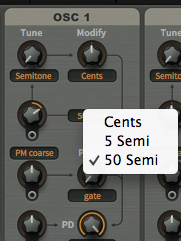
And below that either Phase Modulation or linear FM (Hertz)
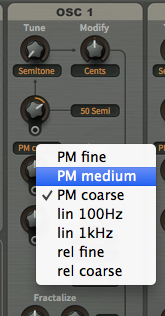
The "relative" option also uses Hertz, bus scales it according to the oscillators base frequency.

-
- KVRian
- Topic Starter
- 567 posts since 21 May, 2016
Okay, so I was only half wrong, then. Since the exponential option does make use of the tune modulation.
As always, appreciate you guys taking the time to address the questions of just some guy trying to learn stuff (me)
As always, appreciate you guys taking the time to address the questions of just some guy trying to learn stuff (me)
-
- KVRAF
- 4197 posts since 23 May, 2004 from Bad Vilbel, Germany
It's phase modulation (like the Yamaha DX series and Bazille's "PM" modes).Autobot wrote:Sorry to be off topic but the FM used in Zebras FMO-Modules is PD or?