18 KVR members have added Air-G Dess to 15 MyKVR groups 19 times.
Download KVR Studio Manager (FREE)
Air-G Dess is part of Air-G Audio, a collection of plugins built on the open source work of Airwindows, Chris Johnson's project that has been releasing some of the most carefully crafted free DSP algorithms in the audio world.
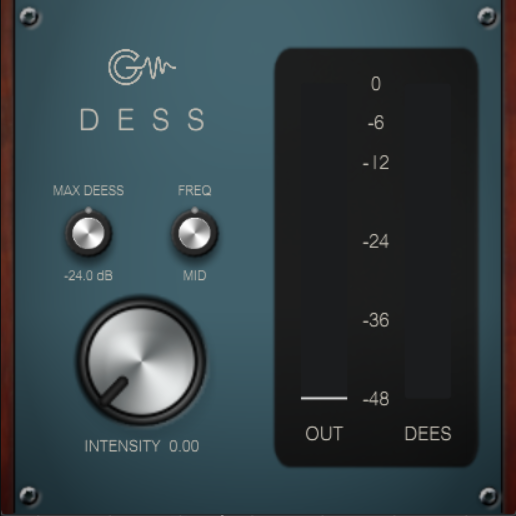
Dess is a de-esser, but it works differently from most. Instead of targeting a fixed frequency range and turning it down when it gets too loud, it reads the shape of the waveform itself, looking for the rapid, almost chaotic reversals that characterize a real "s" sound. The result is a precision that conventional de-essers struggle to match: if something is bright but not a true sibilant (a cymbal, a breath, a harmonic), Dess leaves it alone. The interface adds an Intensity control for aggressiveness, a Max DeEss ceiling so reduction never goes too far, a FREQ control that adjusts the color of the targeted sibilance from the sharpest extreme down to the body of the "s" sound, and two dBFS meters for output and sibilance reduction.
The engine is Airwindows' DeEss, and FREQ is where the character lives. At the brightest end, it works like a conventional de-esser on the sharpest frequencies. Pulled toward the lower range, it starts affecting the body of the sibilance too, and the vocal begins to sound as if it were recorded with a dynamic microphone rather than a bright condenser. The DEES meter makes calibration direct: when it moves only on "s" sounds and stays still the rest of the time, the sweet spot is found.
Dess is most useful on lead vocals, spoken word, podcast, and voiceover, especially with condenser microphones that tend to exaggerate sibilance. It also works on instruments with sharp, problematic attacks in a mix.
---
Air-G Audio is a collection of plugins built on the open source code of Airwindows. The project is built around adding a graphical interface that makes the experience more comfortable and visual, along with a few features that expand the possible uses without straying from the original sound. The simplicity and lightness of Chris's code are the starting point and the guide.
Thanks to Chris Johnson for making his work public and accessible. Air-G Audio exists because Airwindows exists. The Airwindows code used in this plugin is published under the MIT License.
Air-G Dess is free. You can download it without paying anything, following the same open philosophy that runs through all of Chris's work. If the plugin is useful to you in your music, a contribution is always welcome. Chris Johnson's Patreon is also worth knowing about: it's the most direct way to support the Airwindows project and the work that makes plugins like this one possible. patreon.com/airwindows.
Available for Windows, Linux and macOS.
*New: Windows & Linux — All VST3, no installer download
***Windows note: the installer is not signed with a paid certificate, so SmartScreen may show a "Windows protected your PC" warning. Click "More info", then "Run anyway" to continue. This is expected and not a problem with the plugin.
***macOS note: the plugin is not signed with an Apple developer certificate, so Gatekeeper may block it on first use. The "Open Anyway" option in System Settings does not work reliably for audio plugins. The correct fix requires Terminal:
1. Open Terminal (Applications > Utilities > Terminal).
2. Type: sudo xattr -rd com.apple.quarantine (leave a space at the end, do not press Enter yet).
3. Open Finder and navigate to your plug-in folder: VST3 plugins are in /Library/Audio/Plug-Ins/VST3/, and AU plugins (for Logic and GarageBand) are in /Library/Audio/Plug-Ins/Components/. Drag the plugin file (the .vst3 or the .component) into the Terminal window. The path fills in automatically.
4. Press Enter and type your admin password when prompted (it will not be visible). Press Enter again.
5. Rescan your plugins in your DAW. The plugin should now appear. If you installed both the VST3 and the AU versions, repeat the process for each file.

Please log in to join the discussion
Submit: News, Plugins, Hosts & Apps | Advertise @ KVR | Developer Account | About KVR / Contact Us | Privacy Statement | Sell @ KVR | KVR Marketplace Terms & Conditions
© KVR Audio, Inc. 2000-2026