11 KVR members have added EightyEight to 4 MyKVR groups 16 times.
Download KVR Studio Manager (FREE)
FREE BETA.
Modeled after an old Jupiter-8 Studio unit.
OSCILLATORS.
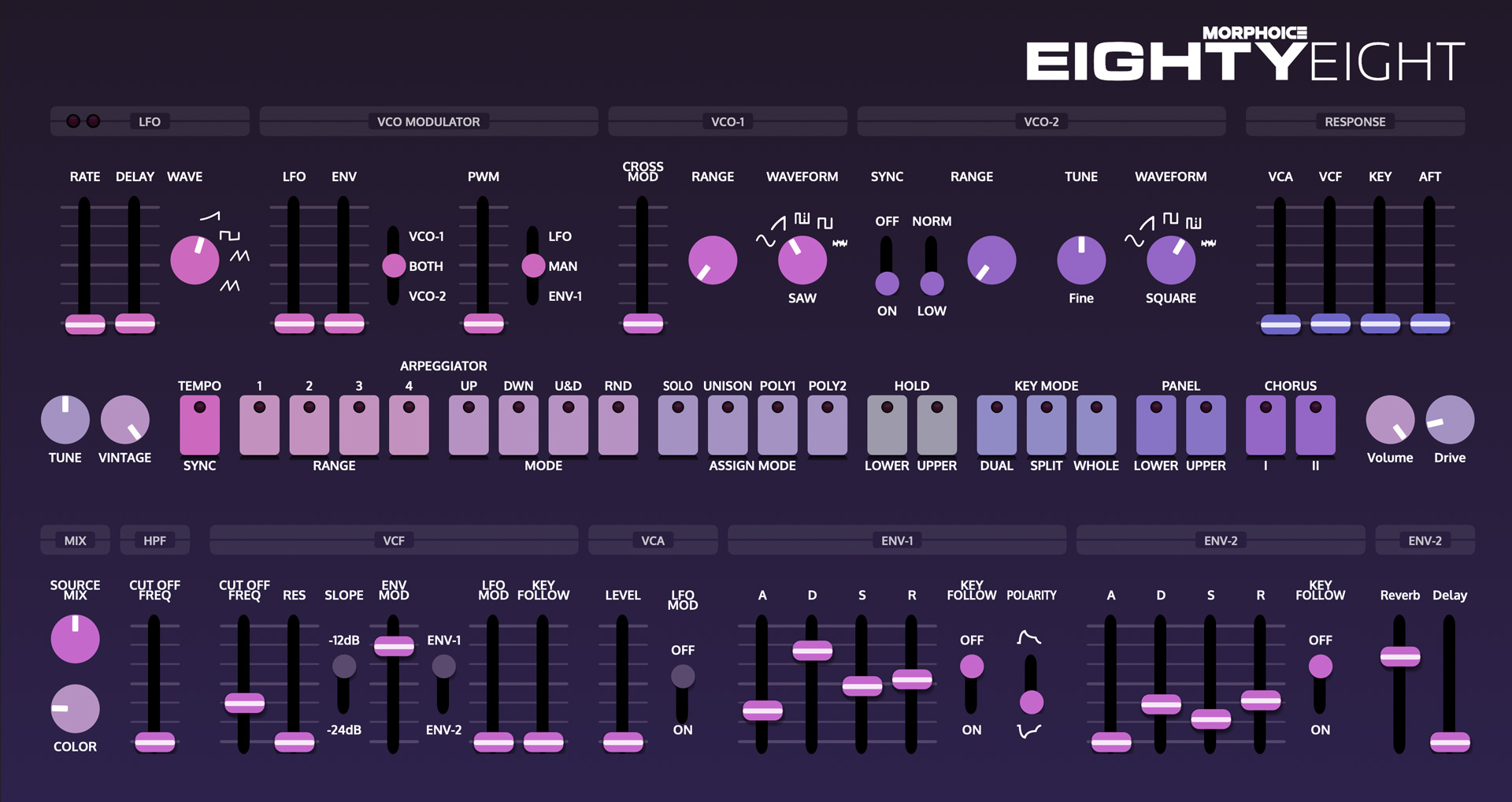
Two oscillators per voice. Unlike the original, both VCO-1 and VCO-2 offer the full set of waveforms — sine, saw, pulse, square and noise — an improvement over the Jupiter-8. Cross-modulation and oscillator sync are modeled straight from the hardware, the heart of its fat, animated sound.
8 VINTAGE VOICE CARDS.
We meticulously modeled the eight vintage voice cards of an old unit, capturing their nonlinearities, detuning, drift and wobble — right down to the DAC scan noise. Each card's filter section carries its own subtle coloration, so no two voices sound exactly alike, just like the real hardware. A VINTAGE slider lets you dial it all in over the idealistically serviced and tuned Jupiter-8 you'd get fresh from the factory — from pristine and pinpoint to characterful, drifting and alive.
FILTER.
The Jupiter four-pole low-pass filter with resonance, plus a dedicated high-pass filter. Modulation by envelope, LFO and keyboard tracking. Capable of everything from glassy pads to screaming resonant sweeps.
ENVELOPES.
Two ADSR envelopes, matched to the original timings.
LFO.
An LFO with multiple waveforms for pitch, filter and pulse-width modulation. Not yet implemented — coming in a future update.
ARPEGGIO & POLY.
8-voice polyphony. The classic Jupiter arpeggiator (up / down / up-down / random) and key hold are not yet implemented — coming in a future update.
EFFECTS.
The Jupiter-8 never had a chorus — so we added the Juno-6 chorus from EightySix, measured from the real hardware, for the lush, shimmering sounds you always wished a Jupiter-8 could make. EightyEight also features the DarkStar Reverb and Delay engine and the HeatBurn Drive/Distortion to bring your sound to the next level.
About the Modeling.
EightyEight is a circuit-modeled emulation built from measurements taken on a Roland Jupiter-8. The oscillators, filter and envelopes are each modeled from the corresponding hardware sections rather than approximated with generic virtual-analog building blocks. We went a step further and meticulously modeled the eight individual vintage voice cards of an old unit — their nonlinearities, detuning, drift, wobble and even the DAC scan noise — so a VINTAGE slider can take you from a freshly serviced, factory-tuned Jupiter-8 to a characterful, aged unit and anywhere in between.
What "Circuit Modeled" Means.
Transfer functions are derived from the actual circuit topology of the original synth, focusing on the sections where component-level behavior is audible — the filter nonlinearity, the cross-mod and sync interaction, the envelope curves. Where component-level precision isn't perceptible, lookup tables and optimizations are used to keep CPU usage reasonable. The DSP is written in Faust.
What's Modeled vs. What's Original.
The voice architecture, filter, envelopes and LFO are modeled from the hardware. The full waveform set on both oscillators is our own improvement over the original. The chorus is the Juno-6 chorus borrowed from EightySix — the Jupiter-8 never had one. The reverb and delay are original additions too: the DarkStar Reverb is a granular shimmer design inspired by the Strymon BigSky and Eventide processors with a smeared, textural character of its own, and the delay is a lofi tape delay with charming wow and flutter.
Reviewed By EgonTwo [all]
June 30th, 2026
Version reviewed: 0.0.9 on Windows
I ran a quick test on this new synth. There seems to be a spurt of new plugins these days. While it's exciting to see all the new toys, it seems like a lot of them are vibe coded by inexperienced developers. Too many feel like they were Frankenstein-ed together from a bunch of code libraries, and let loose to the village.
The sad truth seems to be that they and this plugin feels half hatched. There is no file/patch saving system. Adjusting some parameters causes crazy exploding noises. The basic sounds are fine. This is version 0.0.9. So, hopefully by the time it gets past a few of those zeros, it will have matured to a usable piece of kit.
But given the sheer number of plugins coming out now... and the number of good plugins doing basically the same thing, the user is well advised to be discerning in their choices of what tools to actually commit to using.
Response from Morphoice from Morphoice on June 30th, 2026
Thanks for taking the time to look at it. Some important context for anyone reading: this is an explicitly-labeled early beta, version 0.0.9, released specifically so people could audition the voice card modeling.
A couple of corrections, though. The patch saving system isn't missing, it's there. And the parameters that misbehave when pushed aren't broken so much as unfinished, which is stated up front, since this beta was put out to demo the oscillators, not as a feature-complete release. So a fair bit of what's flagged here as a shortcoming is really just "not done yet," or in the case of patch saving, already done.
For the record, my plugins are hand-written DSP modeled from the actual hardware on my bench, not assembled from code libraries. The finished version will carry the full feature set; this beta was never meant to be judged as one. Glad the core sound came across well, that's exactly what I released it for.


Why it's marked as free when it's only free through the beta period? that's like a generous trial version, but not free.

FWIW, if you donate $10 while it's in beta, he'll send you a license for the full version.
Please log in to join the discussion
Submit: News, Plugins, Hosts & Apps | Advertise @ KVR | Developer Account | About KVR / Contact Us | Privacy Statement | Sell @ KVR | KVR Marketplace Terms & Conditions
© KVR Audio, Inc. 2000-2026