1 KVR member has added Hiss to 1 MyKVR group 1 time.
Download KVR Studio Manager (FREE)
Hiss is a spectral processor for selective control of resonances and noise-like content.
It was originally developed as a different kind of de-esser for mastering, where broad de-essing can easily affect vocal clarity, cymbals, ambience, and the overall high-frequency balance of a finished mix.
Rather than treating an entire sibilant sound as one problem, Hiss separates the selected frequency area into complementary components:
This makes it possible to reduce harsh resonances while preserving the airy or natural noise component around them. It can also be used the other way around: reducing noisy, gritty, or distorted energy while retaining tonal definition.
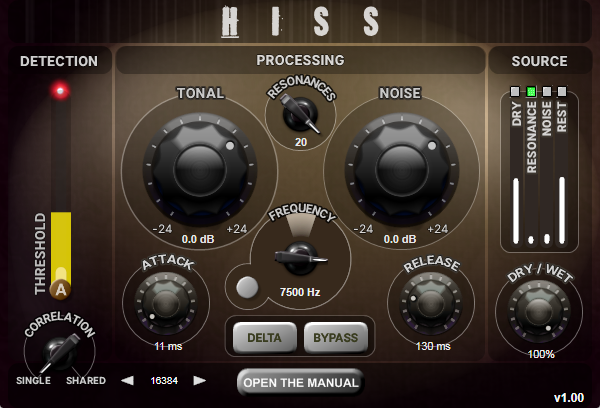
Hiss can detect between 1 and 20 resonances within a user-defined frequency range. The Frequency control sets the centre of the working area, while Correlation determines how wide that range is.
The Resonances control determines how many of the strongest resonances Hiss should address. A low value can be used to focus on one or two narrow peaks, while higher settings are useful for dense material with several problematic resonances.
Hiss covers the full audible spectrum from 20 Hz to 20 kHz, making it suitable for more than vocal de-essing. It can also be used for ringing acoustic instruments, harsh cymbals, brittle synths, distorted guitars, upper-midrange buildup, low-mid resonances, and general spectral shaping.
The large Tonal and Noise controls adjust the level of the separated components independently. Both controls range from -48 dB to +24 dB.
For example, a vocal S sound may contain both sharp tonal peaks and a broadband noise component. Lowering Tonal while leaving Noise unchanged can reduce the piercing quality without making the vocal sound dull, lisped, or filtered.
In other cases, the unwanted character may be mainly noisy rather than resonant. Reducing Noise can then be more effective than conventional de-essing or broad dynamic EQ.
The controls can also be used creatively. Resonances can be emphasised, noise textures can be brought forward, and the internal balance of a sound can be reshaped in ways that are difficult to achieve with traditional EQ.
The Source selector determines which part of the signal Hiss uses for detection:
Resonance is usually the most useful source for sharp, piercing, or ringing material. Noise can be useful when the problem is rough, distorted, diffuse, or gritty rather than tonal.
The Threshold determines when Hiss begins processing. The small A button beside Threshold automatically adjusts the level feeding the detector, giving the Threshold control a more useful working range after changing the source, frequency, or correlation settings.
Attack and Release controls adjust the timing of the processing. Fast settings provide tighter control, while slower settings can create a smoother and more relaxed response.
Hiss is designed for situations where a conventional de-esser, dynamic EQ, or broad spectral processor gets close but affects too much around the problem. Its purpose is to identify the part of the sound that actually needs attention and leave the useful material intact.


Please log in to join the discussion
Submit: News, Plugins, Hosts & Apps | Advertise @ KVR | Developer Account | About KVR / Contact Us | Privacy Statement | Sell @ KVR | KVR Marketplace Terms & Conditions
© KVR Audio, Inc. 2000-2026