13 KVR members have added PyPhonic to 6 MyKVR groups 19 times.
Download KVR Studio Manager (FREE)
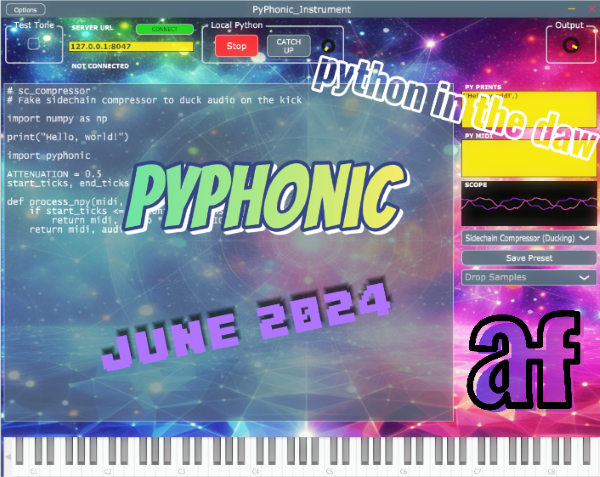
With PyPhonic you can edit and run Python code directly in the DAW, in realtime. It can process both audio (stereo or mono) and MIDI input, returning audio and MIDI output. It can be placed on your tracks like any other VST, as either a synth, an effect, or a MIDI generator. The Python version is 3.12 and PyTorch, NumPy, SciPy and others are installed alongside the standard library. MIDI is transformed as a standard list, whereas you can choose list, NumPy array, or Torch tensor for the audio data, and even process it on GPU.
Alternatively, and this is useful if you're for example using CoPilot as a coding assistant, you can stream audio and MIDI to a server elsewhere which will do the processing. There's a pip-installable Python library to run a server with hot reload.
Two plug-in versions are included, an instrument and an effect. Both accept and return audio and MIDI; this is for convenience depending on how your DAW can be configured. A standalone version is also included that can process mic and loopback audio as well as MIDI.
While PyPhonic includes a few useful functions like for getting transport info and BPM from the DAW, there is no complex syntax to learn; processing is pure Python/NumPy/Torch. For example, this is all you need to swap L/R channels and add some gain using NumPy:
def process_npy(midi, audio):
audio[0], audio[1] = audio[1], audio[0]
return MIDI, audio * 1.1
A number of presets are included with PyPhonic which are in the Github repo for the Python library (this is automatically refreshed when you load PyPhonic in the DAW). They include a polyphonic synth, a saturator, a sidechain compressor, a MIDI arpeggiator, a time stretcher, a wavetable synth, generative MIDI drums, a neural net voice changer, a drum sampler, a Butterworth filter and more.
Here's a YouTube demo of some of the audio effects:
{See video at top of page}
Reviewed By rdoursenaud [all]
July 17th, 2024
Version reviewed: 1.1.1 on Windows
Very fun to try out custom algorithms ideas.
Python is the perfect language for iterative exploration.
Works equally well for sound processing and generation / synthesis.
Price is very fair.
Give it a try.

Please log in to join the discussion
Submit: News, Plugins, Hosts & Apps | Advertise @ KVR | Developer Account | About KVR / Contact Us | Privacy Statement | Sell @ KVR | KVR Marketplace Terms & Conditions
© KVR Audio, Inc. 2000-2026