6 KVR members have added Wake to 2 MyKVR groups 8 times.
Download KVR Studio Manager (FREE)
{See video at top of page}
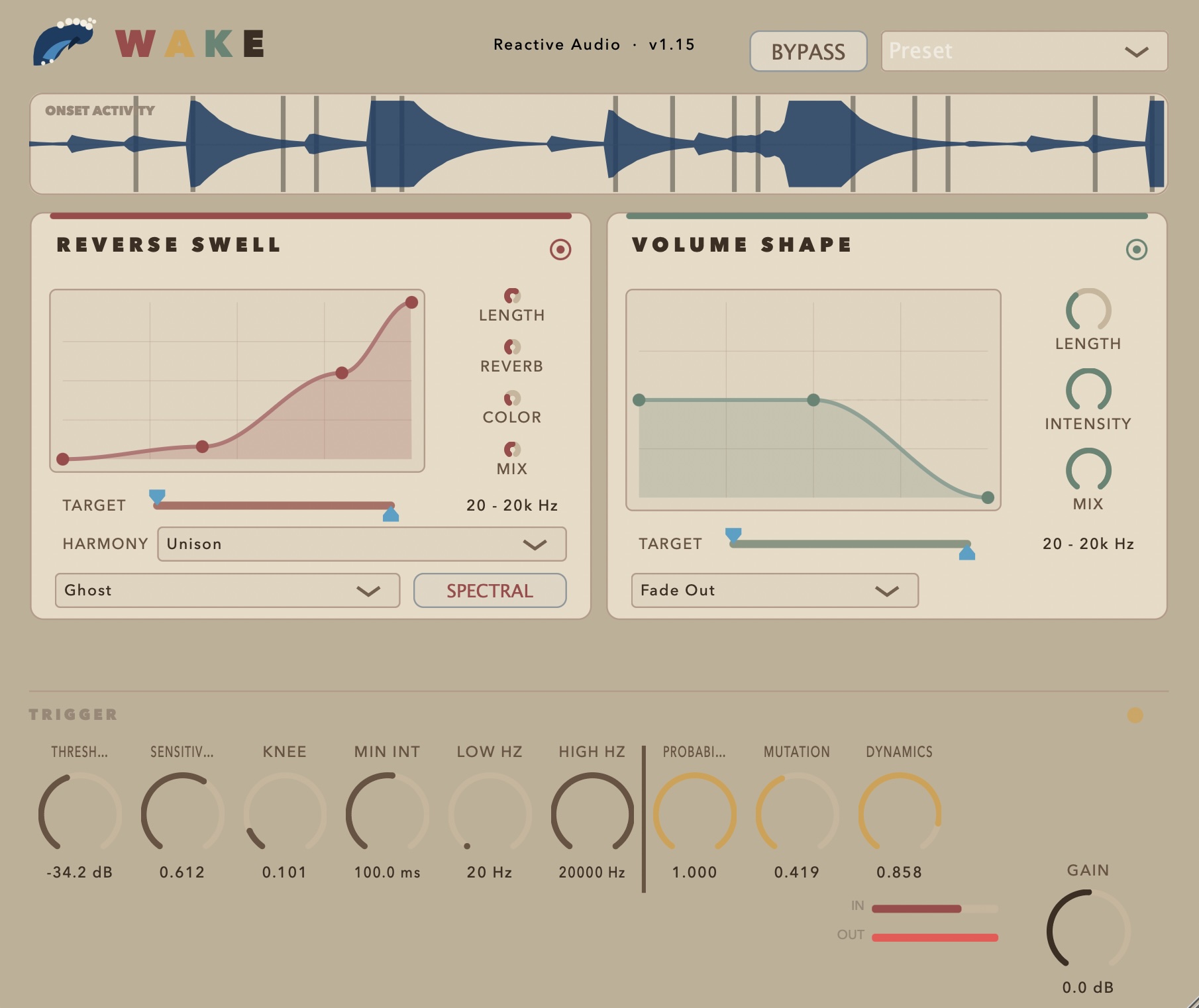
Wake isn't a shaper — it's a transient-triggered swell instrument. It detects every transient in your audio and, for each one, generates a swell that rises into the hit and resolves exactly on it (a pre-echo, via look-ahead).
In Spectral mode the swell is resynthesized from the hit's own spectrum and can bloom into a chord — octave, fifth, power, major, minor, octave stack — so a kick blooms into a tonal sub-riser and a vocal hit into a harmonized swell rising into the word. A Color control sweeps the swell from dark to bright into the transient. There's also a reverse-reverb swell mode, a drawable Volume Shape fired per hit (ducks, pumps, tremolo, stutters), per-onset dynamics that scale each effect to the hit's loudness and brightness, multiband targeting, and an onset-activity visualizer.
Because Wake generates new, pitched material from each hit rather than reshaping existing audio, it does things grid- or audio-triggered shapers structurally can't. A mix-time tool — look-ahead latency is reported to the host for transparent delay compensation.
Version History
v1.3 — Direction control: leave it on Before for the classic swell that rises into the transient, switch to After for a tail that blooms out of the hit and decays, or Both to fire a riser and a tail from one onset. It works in both swell modes (Reverb and Spectral) and respects the harmony, Color, and target band. Pitch riser: a bipolar sweep of up to two octaves. Positive sweeps the swell up into the hit and resolves on its true pitch (a classic riser); negative dives down; in tail mode the sweep runs outward instead.
v1.25 — Latency control (Low / Medium / High) — Wake's swells are a pre-echo, so they need look-ahead, which is the plugin's latency. Lower settings cut the latency for interactive / MIDI-driven use, at the cost of a shorter maximum swell. High (1.5 s) is the default and preserves the original behaviour. Makes the MIDI-controlled harmony far more responsive to play.
v1.2 — MIDI-controlled harmony: route a MIDI chord to Wake and every hit's swell harmonizes to what you play, in real time. Windows support added (VST3).
v1.15 — Harmonized swells (the spectral bloom can now build a chord from each hit — octave, fifth, major, minor, and more). New Color control: a lowpass that opens as the swell rises into the hit. UI refinements; new $20 launch price.
v1.1 — Spectral swell mode: each swell resynthesized from the triggering hit's own spectrum. Trigger Response: soft-knee triggering (glancing hits get a smaller effect) and peak alignment (swells land on the transient's true peak).
v1.0 — Initial release. Transient-triggered Reverse Swell (a reverse-reverb that builds into each hit) and drawable Volume Shape. Onset detector with frequency-range trigger filter, per-onset dynamics, multiband targeting, onset-activity visualizer, global bypass, 8 factory presets. VST3 / AU / Standalone (macOS).
Every few months a plugin shows up that's hard to file under an existing tab, and Reactive Audio's Wake is one of them. On paper it sounds like another audio-reactive effect. It detects transients in your audio and does something on each hit, and we've seen that before. But Wake isn't a shaper. It doesn't reshape the audio that's already there. It generates new sound that builds into every hit, and that one design choice makes it feel like a different category entirely.
The core idea
Drop Wake on a drum bus and play. For every transient it detects, it grows a swell that rises and resolves exactly on the hit, a kind of pre-echo. In Reverb mode that swell is a reverse-reverb of the hit. In Spectral mode it's resynthesized from the hit's own frequency content, which is where things get interesting. Because the swell is built from the sound that triggered it, it carries that timbre. A vocal blooms into a vocal-ish wash, a synth into a synth-ish riser, and it's all locked to the performance rather than a tempo grid.
It uses look-ahead to pull this off, so there's latency (your DAW compensates for it). That makes Wake firmly a mix-time tool rather than something for live monitoring, and the manual is upfront about it. Fair enough.
The 1.2 headline: MIDI-controlled harmony
The marquee addition in 1.2 is the one that made me sit up. In Spectral mode you can set Harmony to "Played (MIDI)", route a MIDI chord to the plugin, and the swells bloom into whatever you're holding. Hold a Cmaj and your hits harmonize to Cmaj. Move to Am and they follow. On a sustained vocal or a melodic plucked source it's genuinely lovely. You get these harmonized risers that move with the song, the kind of thing you'd normally automate by hand or layer in by ear. It turns an effect into something closer to a playable instrument.
On drums it's more of a coloration than a clean chord. Drums are mostly inharmonic, so you get a tuned, harmonic halo rather than a piano voicing. As an atmospheric riser under a build, it works a treat.
Niggles
A few. Routing MIDI to an audio-FX plugin is DAW-dependent. It's painless in Bitwig, Ableton, FL and Reaper, but fiddly in Logic, where AU effects don't take MIDI gracefully (a macOS limitation, not really Wake's fault, but worth knowing). The Windows build is brand-new this version and unsigned, so you'll click through a SmartScreen warning on install. And by nature this is a niche tool. It does one unusual thing extremely well rather than being a do-everything box, so whether it earns a slot in your chain depends on whether that thing speaks to you.
Verdict
At $20, Wake is an easy recommendation for anyone who likes sound design that reacts to the material instead of fighting it. Think film and trailer folks, electronic producers chasing risers, or anyone who wants tasteful movement on drums and vocals without drawing automation. The reverse-swell-into-the-hit is the genuinely original bit, and 1.2's MIDI harmony pushes it from "clever effect" toward "small instrument." It won't be on every track, but on the right ones it does something nothing else quite does.
Pros: Genuinely novel concept. Gorgeous spectral and harmonized swells. MIDI harmony is inspiring. Cheap, and cross-platform now.
Cons: Niche by design. Mix-time latency. MIDI routing awkward in Logic.
 12%OFF$69.00Rev SPRING 636
Please log in to join the discussion
Submit: News, Plugins, Hosts & Apps | Advertise @ KVR | Developer Account | About KVR / Contact Us | Privacy Statement | Sell @ KVR | KVR Marketplace Terms & Conditions
© KVR Audio, Inc. 2000-2026