
Maybe i am off but is the top end of Bazille not quite as perfect as Diva?

Official support for: u-he.com
RELATED
PRODUCTS

Post

whyterabbyt wrote:
chk071 wrote:Yes, but can you really model the behavior and sound of the filter that way? I don't think so. What i was trying to say is that it's probably easier to mimic the sound of the oscillator, than the sound of the filter.
Yeah, but what Im saying is that, in the same way that its 'harder' to model, say, the resonance behaviour of an FM'd filter properly (cf the ZDF hullaballoo) its also 'harder' to model complex oscillator interactions properly.
And its not exactly unknown that 'simple' mimics of filter behaviour get used just about as frequently as equally 'simple' mimics of basic analogue oscillators.
Can't and won't argue with that. I just wanted to say that my own, totally unscientific, observation was that the raw oscillator sound isn't so much different on most synths, while the filter behavior can have a deep impact on the sounds. Anyway, that's just my opinion, and as other posts show, others will disagree, which is perfectly fine. :)

Post

chk071 wrote:
Gonga wrote: It's been widely discussed that contrary to what many say, the oscillators have as much, if not more, to do with the overall "sound quality" effect as the filters.
I tend to disagree. I read pretty frequently from dev's oft soft synths that they nail the sound of analog oscillators to 99% or so. Also, every 2nd subtractive soft synths oscillators are modelled after the minimoog oscillators afaik. What often for me makes the difference ARE the filters. There's the whole bandwidth on soft synths, from total crap, to really juicy, soft clean, linear, non linear, whatever. I think you can easily add the analog character of instability or noise on the oscillators by adding the appropriate stuff, but you will have problems mimicking the specific character of a filter, when it sounds different. At least that's the way i feel it's like.
Fair enuf.

One thing I can tell you - DIVA's minimoog VCO sounds very different than my other softsynths I've tried over the years. The filters, yup, them too. A good ear experiment would be to open up the filters with no resonance and compare the VCOs of various "minimoog" softsynths side-by-side. To my ears, that difference is more distinct than the filters. Crummy super-aliasing filters and those that can't be swept without crapping out (hint: ModularV) notwithstanding. YMMV
ALL YOUR DATA ARE BELONG TO US - Google

https://soundcloud.com/dan-ling
http://danling.com

Post

3ee wrote:
Sendy wrote:I should also point out, Bazille is currently the most aliasing of all u-he synths (in my estimation), which might be why the high end sounds a bit frazzly sometimes. For me, that's countered by the fact that the non-aliasing part of the signal sounds *really* good, it has a sharp, vivid, high-def sound that I've never heard before. The aliasing isn't *bad*, but it would be cool to get rid of it somehow.
Exactly! 8) Maybe they'll replace the HQ switch with similar option to what Diva has.

Actually, I was pleasantly surprised with Bazille's osc sound character. It sounds great to my ears, has that thick-plastic feel (especially noticeable with modulation) with some white plastic "vintage" oxide on top. :hihi:
I wouldn't mind an 'Ultra HQ' mode... :ud:

Post

Gonga wrote:
chk071 wrote:
Gonga wrote: It's been widely discussed that contrary to what many say, the oscillators have as much, if not more, to do with the overall "sound quality" effect as the filters.
I tend to disagree. I read pretty frequently from dev's oft soft synths that they nail the sound of analog oscillators to 99% or so. Also, every 2nd subtractive soft synths oscillators are modelled after the minimoog oscillators afaik. What often for me makes the difference ARE the filters. There's the whole bandwidth on soft synths, from total crap, to really juicy, soft clean, linear, non linear, whatever. I think you can easily add the analog character of instability or noise on the oscillators by adding the appropriate stuff, but you will have problems mimicking the specific character of a filter, when it sounds different. At least that's the way i feel it's like.
Fair enuf.

One thing I can tell you - DIVA's minimoog VCO sounds very different than my other softsynths I've tried over the years. The filters, yup, them too. A good ear experiment would be to open up the filters with no resonance and compare the VCOs of various "minimoog" softsynths side-by-side. To my ears, that difference is more distinct than the filters. Crummy super-aliasing filters and those that can't be swept without crapping out (hint: ModularV) notwithstanding. YMMV
I think the Oscillators are at least as important as the Filter

Post

I think Bazille is inspired (at least partly) by some cheap digital synths with phase distortion - Casio CZ series. So perhaps what you hear is the characteristic of this form of synthesis. Mind you, changing the phase distortion base waveform (either cosine, tap map 1, or tap map 2) makes the result STRONGLY digital ;) Good for a different type of sound from the buttery creamy DIVA.
Post

Urs do you have any thoughts on this? Would really like to get your feedback. To respond to the other posters i would strongly agree that the oscillators are what gets the sound of diva so amazing in the hi end and upper mid range.

Post

Adrian B wrote:I think Bazille is inspired (at least partly) by some cheap digital synths with phase distortion - Casio CZ series
This and the DX-style FM by phase modulation. Oscillators were more important to their sound as there were no filters :hihi: (It is possible to feed Bazille through, say, Cytomic's Drop filters - in fact one can send audio panned left, CVs panned right and sidechain that pretty effectively. It doesn't sound like Diva. It doesn't sound like Bazille.)

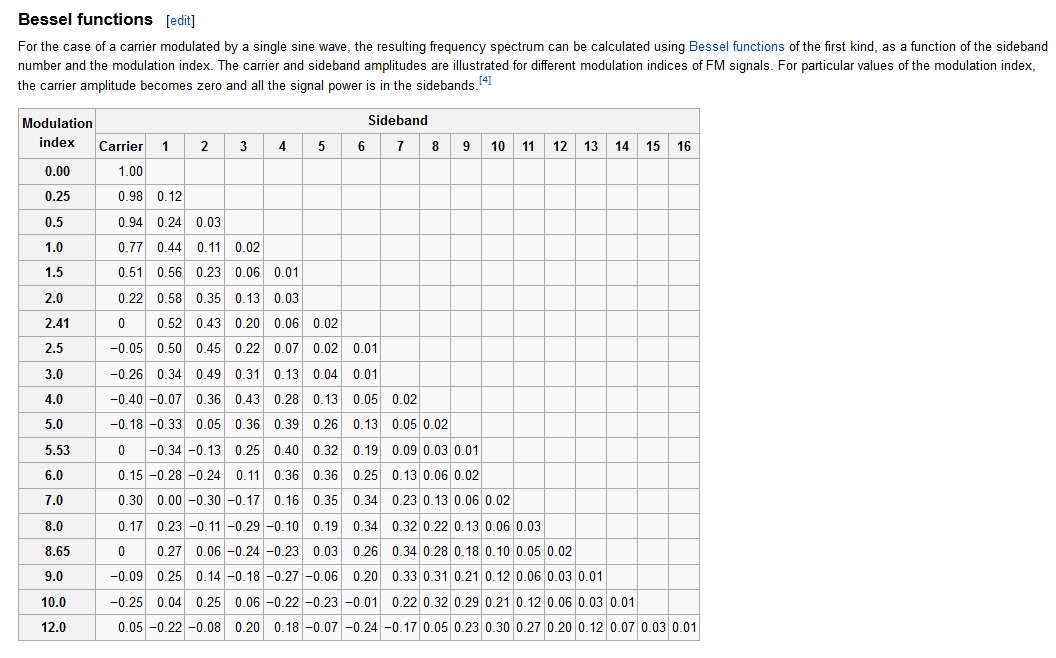
Aliasing aside (Ubik, used as directed, is absolutely safe), occasionally there's another effect at play - the frequency of sidebands with FM is pretty easy to work out but the amplitude, while well understood, involves Bessel functions and gets complicated.

Image

Significantly, sometimes higher depth of FM can lower the amplitude of a specific sideband. If I'm understanding this correctly, this explains some of the rippling on the spectrum when getting into the 'PM coarse' range even with a simple 1:1 ratios and cosines. This rippling would be ... ripplier with complex waveforms as modulators.

Post

Still getting familiar with Bazille's new filters but I do think they're relatively crunchy in a way that makes a ton of sense alongside FM/PD. (Sorry for double post, meant to edit but hit quote)

Post

ddeez wrote:Urs do you have any thoughts on this? Would really like to get your feedback. To respond to the other posters i would strongly agree that the oscillators are what gets the sound of diva so amazing in the hi end and upper mid range.
I'm enjoying a long weekend in Prague, i.e. I'm offline most of the time.

Bazille is a strictly digital synth. Any character of the likes of Diva is something we wouldn't expect.

Post

ok cool i apologize for interrupting ur weekend i know it's well deserved. When u get back i'd love to hear a more in depth response on the topic.

Also, the next thing that comes to mind is: is there ever going to be a product with the amazing sound qualities of diva but with the modulation options of something like bazille (i.e. a modular or semi modular synth) from U-He... I definitely feel Diva and Bazille and Ace have strongly surpassed Zebra in terms of sound quality.

Post

Well, there's not much more to say. Bazille is a digital synth. It utilises FM, PM and PD, coupled with naive wavetables. It aliases easily, even when oversampling.

A synth with the modulation capabilities of Bazille (less the digital part) and the general sound quality of Diva (less the exact emulation) would be: ACE

We'll also see what Berlin Modular brings on the table.

As for Zebra, non of these synths can touch its versatility and sound shaping possibilities. Naturally Zebra doesn't sound as analogue as Diva or as flubbery as Bazille. Non of these will however beat Zebra as our flagship product - simply because Zebra is all the things that these are not.

Post

Ok thanks very much for the response. I guess i feel like Zebra sound quality wise isn't as amazing as Diva (though it still sounds very good). I think ACE sounds even better then Zebra but it doesn't feel 100 percent as good as Diva. Would i be correct in saying that Zebra 3 is going to sound on a level comparable to Diva?

To be more specifc: I think saying Diva does a fantastic job imitating analog is really selling it short. The patches I've made/some of the presets that I've used from Diva that i've had the most success with in my productions, don't sound typically analog at all. I've made some very non analog sounding sounds on Diva that feel so lifelike to me and they sound so amazing and i think it's all cuz of the sound engine.

So in conclusion what i'm saying is i badly want a U-He product that has the sound of Diva but with more modulation options. I bought Dark Zebra from you guys, but i don't feel that is all the way on the level of Diva in terms of sound. And like i said before i think ACE sounds great but is a bit short of Diva level sound. So Urs after reading my too long response (sorry lol) do you think my best prospects are going to be Berlin Modular and Zebra 3? Would really like one last post from you on the topic. Thanks!!

Post

ddeez wrote:I bought Dark Zebra from you guys, but i don't feel that is all the way on the level of Diva in terms of sound.
Well, the filters are exactly the same as in Diva there... So you might be doing something wrong. :D Of course, the oscillators are completely different - but they aren't lower quality just because they're different.

Post

Yeah i know they're the exact same...it's def the osc. that change the sound pretty drastically to me.

Post

But there's nothing inherently "bad" in Zebra's oscillators. :D

Post Reply

Return to “u-he”