


(then again, i'm having a soft spot for Atari's operating system too (as long as it's in monochrome
 )
)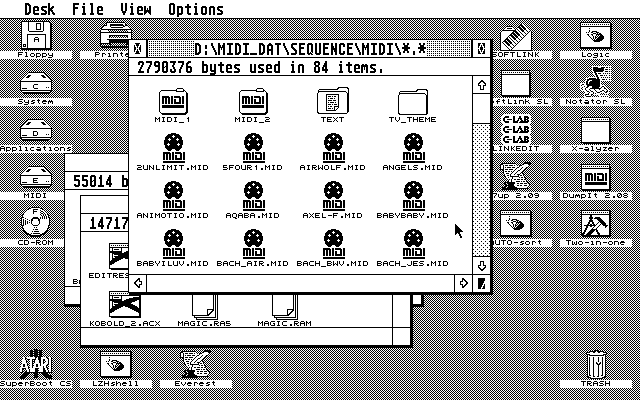 )
)
 I still have a lot of love for the ST...
I had no idea softsynths back then sounded this good (I know there was FM7 back then, and so were the KORG products)! I wonder how much CPU they took up.Urs wrote: Sun Feb 19, 2023 10:16 am Some Zebra 1 demos around early 2004... there were quite a few more by other people, I would have to find some old backups...
https://soundcloud.com/ursheckmann/zebriforge
https://soundcloud.com/ursheckmann/zebraelectric
Apparently the web does forget, as do hard drives... I do not have any screenshots of some of its UI, and I had looked through the backups I found...

Nothing, on today's machines. The number of machines that Zebra 1.0 ran on was comparably small, there were just so and so many Macs, and back then with PowerPC G3/4/5 processors. I remember that an oscillator took up roughly 1% CPU on my machine from 1999. That was pretty good. Synths with a lesser sound (aliasing...) used more.
Thanks for that. You mean Have or Hive 2? A hive oscillator on my 2016 Dell XPS 13 takes anywhere from 4-6% at 16x unison. Maybe it's the DAW reading?Urs wrote: Mon Feb 20, 2023 8:39 amNothing, on today's machines. The number of machines that Zebra 1.0 ran on was comparably small, there were just so and so many Macs, and back then with PowerPC G3/4/5 processors. I remember that an oscillator took up roughly 1% CPU on my machine from 1999. That was pretty good. Synths with a lesser sound (aliasing...) used more.
Today, on a 4 years old machine a Hive oscillator takes up something like 0.3% CPU at 16 x unison. Hive's oscillator has evolved from those in Zebra 1.0. Back then it would have been CPU hog, probably using 10% or more (per oscillator, per voice!).
Dunno, I've got a built-in CPU meter for each algorithm. It's very precise.Korg Supporter wrote: Mon Feb 20, 2023 1:46 pm Thanks for that. You mean Have or Hive 2? A hive oscillator on my 2016 Dell XPS 13 takes anywhere from 4-6% at 16x unison. Maybe it's the DAW reading?
Using Logic 6 (PPC) on a G4 Powerbook, Zebra 1.x was generally friendly enough to use without problems on that machine, as were the inbuilt Logic instruments like ES1, ES2, EXS24 and so on. Sculpture was a bit heavier.Korg Supporter wrote: Mon Feb 20, 2023 1:21 am I had no idea softsynths back then sounded this good (I know there was FM7 back then, and so were the KORG products)! I wonder how much CPU they took up.
 ) with virtual instruments on that machine (the Powerbook was my first Mac, but my main DAW was still a PC running Logic 5.x at the time.) I'd have to check my backups for other plugins I was using at the time, I can't remember them all offhand.
You gotta see if you can do a screen recording of Zebra1! I don’t even know if that’s possible on a machine like that but man that’d be so cool!!!beely wrote: Mon Feb 20, 2023 4:06 pmUsing Logic 6 (PPC) on a G4 Powerbook, Zebra 1.x was generally friendly enough to use without problems on that machine, as were the inbuilt Logic instruments like ES1, ES2, EXS24 and so on. Sculpture was a bit heavier.Korg Supporter wrote: Mon Feb 20, 2023 1:21 am I had no idea softsynths back then sounded this good (I know there was FM7 back then, and so were the KORG products)! I wonder how much CPU they took up.
The one at the time I remember that could really max out the CPU was Minimonsta, especially in unison mode, or with chords. That was just a bit too heavy for that machine unless you limited what you did with it.
Obviously, I had a freeze a lot to do much of note (
So that might give some idea of relative CPU use.

Just hook it up to your VCR.... and record it externally.TENETfanboy wrote: Mon Feb 20, 2023 6:56 pm You gotta see if you can do a screen recording of Zebra1! I don’t even know if that’s possible on a machine like that but man that’d be so cool!!!

I hate to make you feel old here, but 2016 would be a seven year old CPU, not four.Korg Supporter wrote: Mon Feb 20, 2023 1:46 pm Thanks for that. You mean Have or Hive 2? A hive oscillator on my 2016 Dell XPS 13 takes anywhere from 4-6% at 16x unison. Maybe it's the DAW reading?
Oh, sorry I misread it. Its CPU is an i7 6560U (paired with 16 GB RAM). Also last night, I did two tests at 41 kHz and 512 samples. I was able to run at least 55 instances of Hive playing Acidity, and I was able to run 28 instances of a 6-note polyphonic unison and filtered pulse patch at 140 BPM (Studio One 5).MitchK1989 wrote: Tue Feb 21, 2023 10:30 pmI hate to make you feel old here, but 2016 would be a seven year old CPU, not four.Korg Supporter wrote: Mon Feb 20, 2023 1:46 pm Thanks for that. You mean Have or Hive 2? A hive oscillator on my 2016 Dell XPS 13 takes anywhere from 4-6% at 16x unison. Maybe it's the DAW reading?

Can we get it as a modulation source?Urs wrote: Mon Feb 20, 2023 2:45 pmDunno, I've got a built-in CPU meter for each algorithm. It's very precise.Korg Supporter wrote: Mon Feb 20, 2023 1:46 pm Thanks for that. You mean Have or Hive 2? A hive oscillator on my 2016 Dell XPS 13 takes anywhere from 4-6% at 16x unison. Maybe it's the DAW reading?
...
Submit: News, Plugins, Hosts & Apps | Advertise @ KVR | Developer Account | About KVR / Contact Us | Privacy Statement
© KVR Audio, Inc. 2000-2026