Howdy!
I've been working on a collection of physically-modelled analog plugins: WD Analog Collection
If you want to go straight to the audio demos, here you go!
These aren't curve fits — each one solves its circuit while the audio runs through it, and every module has a rear panel with the service trims the hardware kept inside. Sixteen plugins, free, Windows VST3 + CLAP. Click a faceplate for the full-size shot.

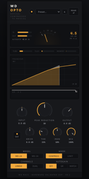
WD Opto — optical tube compressor in the LA-2A bloodline. The photocell has real memory, plus drive and iron knobs the original never gave you.

WD Mu — vari-mu built on a simulated 6386 push-pull pair. No threshold knob; you drive it and it leans back.

WDTec — passive tube EQ, program and mid sections. The filter inductors have live magnetic cores and a knob for how hard you push them.

WD Tape — a full tape machine: record head, bias oscillator, repro head, aligned by the same procedure a tech would use.

WD XQ — one parametric EQ, five circuits underneath, dynamic bands on all of them.

WD FET — the 76 with its actual ratio-button network, so button chords and all-buttons come from the circuit, not a preset. Plus 760, germanium, and clean laws.

WD VCA — stereo bus compressor around one Blackmer-style cell. Console Bus for glue, RMS Punch for drums.

WD Duress — curve-family compressor in the Distressor spirit. Every ratio is its own machine, from 1:1 warm-up distortion to Nuke.

WD Clamp — three compressor slots (Opto/Mu/FET/VCA engines) sharing one power supply. Slam one slot and its neighbors feel it.

WD Pre — five preamps behind one gain knob, from precision wire to a cassette 4-track desk channel.
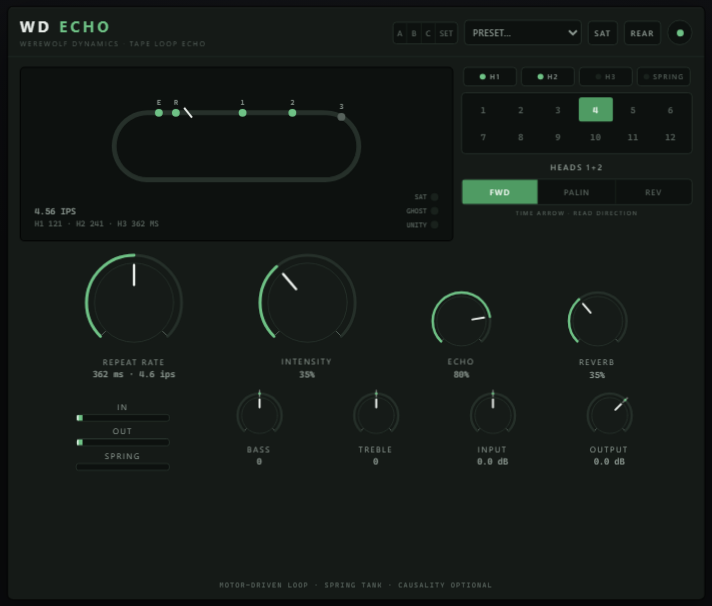
WD Echo — tape loop echo with a motor and a splice. Turn the rate and the repeats already on the loop bend with the transport. Reads forward, palindrome, or backward.

WD AX — exciter built from the patents: a generated sideband, not an EQ boost, so the fundamental never moves.

WD Strip — preamp into EQ into compressor in one window, a model selector on each stage, all three on one power rail.


WD Delta — send/return pair that measures your whole chain's latency and plays you the difference it makes. Works across any plugins, anyone's.

WD Rack — the chassis. Same frame number on your modules and they share a supply: rail sag, slot bleed, reorderable slot map. Skip it and everything runs clean standalone.
How do we know they're accurate? The whole method is written up here: ACCURACY.md — published numbers in, automated bench on every build, all sixteen audited against their hardware's spec sheets.
Free to use on anything, commercial included. Bug reports welcome on the issue tracker — betas move fast.