


Eplex7 DSP releases Equelectrium EQA-1 – VST plugin equalizer with "Sectio aurea EQing technology"

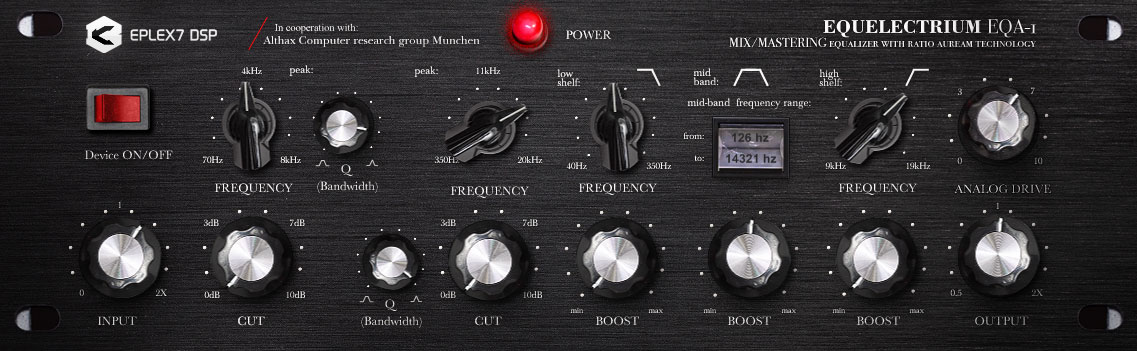 Eplex7 DSP has released Equelectrium EQA-1, a VST2, VST3 plugin equalizer for Windows.
Eplex7 DSP says Equelectrium EQA-1 is based on a brand new technology and style of equalization with totally different sound results, called "Sectio aurea EQing technology".
Eplex7 DSP team said about the development:
Based on our personal experience and professional practice (more than 17 years of constructing analog audio devices and coding DSP software), when we compared the result of real analog equalizers with digital EQs, most of digital EQs produces harsh digital sound when boosting – sharp unpleasant digital sounding transients and trebles, harshness, squared bass, artifacts instead of color, etc. (Personally, we do not want to offend anyone with this statement, but honestly, our dissatisfaction with the results was the beginning of the development of the Equelectrium EQA-1.).
Usually you can hear it better (or only) after mastering at high volume levels. (You can do test of equalizers – put EQ on master channel or equalize complex audio material with mixed many channels together and put limiter after it at commercial level like -8RMS.).
After mastering / limiting your track is probably sounding harsh and unpleasant on transients and trebles if you use boosting of digital eqs in your mix – you can hear it best with high quality hi-fi system or loud PA system in club. You think problem is with your mixing skills, maybe too much limiting, compression etc. which causes distortion and artifacts, right? Yes maybe, but surprisingly most of problems are usually caused by digital equalizers and too much boosting of various eq frequencies (mostly mids and trebles). Why?
Because digital equalizers works on different principles than analog one.
While analog equalizer works with real electric signal digital eq is boosting just numbers and doing digital calculations. This causes various problems with sound and sound become digital and unnatural. After discussions with many experienced mix and mastering engineers + our own experiences we realized that source of harsh unpleasant sounding mixes is mostly equalizer not just dynamic processors.
Inspired by this knowledge we have experimented with various new kind of algorithms which will eliminate the above-mentioned problems of digital equalizers.
After a long time of the development we created brand new DSP technique which draws from theory of equilibrium and Fibonacci / Sectio Aurea (Golden Ratio) both in frequency and amplitude domain.
This algorithm significantly removes disharmony in whole frequency range caused by equalization. It eliminates digital harshness – ugly digital transients and trebles, while the sound is boosting. The sound is more natural, trebles are softer less digital, transients are natural not sharp and artificial, bass is fat and round, similar to analog hardware equalization.
We also integrated many algorithms simulating real analog circuits. Various methods of analog emulation were used from capturing hardware to digital simulation of electronic circuits and components.
Probably you don't hear significant difference from one EQ to another until record is mastered at high volume levels. Where all problems like harsh trebles, digital artifacts, ugly transients are boosted 5-10x in mastering or when you use eq on just one channel like drums, synth or piano. But problems are accumulated when inferior equalizer is used on 8-20 individual mixer channels and then mastered. You are probably thinking why my mix / master is not sounding so good, so sweet natural and pleasant on good hi-fi or in the club.
Try to remove all equalizers (and other mix processors) from the mix. Use just Equelectrium EQA-1 plugin equalizer on every mixer channel (and master stereo bus if needed). Make mastering and compare significant difference on high quality hi-fi system like Bowers & Wilkins, Tannoy, KEF, PMC etc. (not classic near-field monitors which usually do not translate high frequencies, color and transients well because are designed for long work to remove ear fatigue). Don't worry about your mixes, don't spend hours or weeks on them while still sounding digital, harsh and unpleasant. Try new technologies and more comfortable ways.
A few words about the Sectio aurea EQing technology:
During development, we were inspired by the knowledge of Equlibrium and principles of the Golden ratio / Fibonacci numbers, which became the basis of our new type of algorithms.
These theories were researched and applied in their work by many prominent personalities of the world in various industries. For example: the well-known astronomer, physicist, optician and mathematician Johannes Kepler, one of best philosophers Siddhartha Gautama known as Buddha, famous mastering engineer Bob K., financier and philanthropist George Soros and others.
Golden ratio technique was used / is used in art, photography, architecture and music because it seems to be most natural for our brain.
Simply put, moving any system too much over imaginary equilibrium (normal state) up or down creates instability, and this applies in music as well as in mixing. You can learn more at our website
Features:
- Sectio Aurea / Equelectrium technology of Equalization inspired by Fibonnaci / Golden ratio and system of equilibrium in nature. (Please read description and philosophy of development above) which removing almost all ills of classic digital eqs (and digital analog emulations) audible when eq is boosting like: harsh trebles, digital artifacts, sharp artificial digital sounding transients, squared bass etc. and imbalance in mix.
- Realistic emulation of analog circuits and components using various techniques from capturing real hardware to virtual circuits technology (based on 17+ years of experience with constructing analog hardware and DSP coding, see Eplex7 DSP analog labs). Equelectrium EQA-1 simulates sound of solid state (transistor based) analog hardware equalizers and its color. Transistor based EQs / hardware has precise, less colored sound.
- High frequency air band (high shelf with more Baxandall type analog curve) from 8 to 19kHz, from classic analog treble to precise high frequency air – with clean detailed trebles and transients without unwanted harshness and artifacts.
- Bass frequency band from 40 to 350 Hz, with fat round analog style bass.
- Mid range frequency – band pass filter with frequency range based on frequency of bass and high frequency circuit. From 40 to 19 kHz with intensive warm analog solid state sound.
- Cut / attenuate circuit with adjustable frequency from 70 Hz to 8 kHz, from sharp to wide Q (bandwidth) control and cut from 0 to 10db. Very clean and "creamy" sounding cut inspired by passive filters.
- 2nd Cut / attenuate circuit with adjustable frequency from 350 Hz to 19 kHz, from sharp to wide Q (bandwidth) control and cut from 0 to 10db. Very clean and "creamy" sounding cut inspired by passive filters.
- Input knob to control level of input knob (and also amount of color – louder signal = more analog color and saturation mainly when analog drive knob is activated – turned right).
- Analog drive knob – To add analog hardware warmth of transistor based hardware with transformers from very gentle color and saturation to more intensive saturation, warmth + softening and rounding of trebles / transients caused mainly by isolation coil transformers in analog machines.
- Output knob to adjust output volume.
- Preset manager: Only available in full version (settings are reset after every use / opening of project in Demo version.).
Compatibility: Windows 32-bit / 64-bit VST host, VST3.
Download demo version: eplex7.com/equelectrium-eqa-1-plugin-equalizer
Price: 89,00 €. There is an introductory price for first 100 customers of: 22,90 €.
Videos:
