


The Best Granular Synthesis Plugins in 2026: From Theory to Practice
![Nate [KVR]](https://www.kvraudio.com/forum/download/file.php?avatar=506958_1768372953.jpeg) By Nate [KVR] on
By Nate [KVR] on
Granular synthesis plugins have moved a long way from the academic fringes. What began as a theoretical framework in the 1950s and a labor-intensive computer music technique in the 1970s is now available in every major DAW and dozens of third-party instruments. This guide covers how granular synthesis works, where it came from, and which software options are worth your time in 2026.
How Granular Synthesis Works
Granular synthesis operates by slicing an audio source — a sample, a live input, or a generated waveform — into short segments called grains. Each grain typically runs between 1 and 100 milliseconds in duration. The synthesizer then plays back these grains simultaneously or in sequence, with control over the following core parameters:
- Grain size — the duration of each grain
- Grain density — how many grains are active at any given moment
- Grain position — where in the source audio each grain is read from
- Pitch/transposition — playback pitch of each grain, independent of source position
- Scatter/randomization — stochastic variation applied to position, pitch, and timing
- Grain envelope — the amplitude shape applied to each grain (typically a Hann or Gaussian window to prevent clicks at grain boundaries)
Manipulating these parameters produces a synthesis technique capable of generating anything from natural-sounding time-stretching and pitch-shifting to entirely synthetic, cloud-like textures with no recognizable relationship to the source material.
A Brief History: From Xenakis to the DAW

Source: The Friends of Xenakis
The theoretical foundation was established by Greek-French composer Iannis Xenakis in 1959. In Formalized Music and in compositions such as Analogique A and Analogique B, Xenakis described sound as a statistical assembly of elementary sonic particles — grains. Practical implementation at the time required tape splicing, making most of his ideas compositional proposals rather than reproducible technique.
Curtis Roads produced the first computer implementation of granular synthesis in 1974. His later book Microsound (2001) remains the most thorough technical reference on grain-based audio processing.
The first real-time granular synthesis system came from Barry Truax in 1986, using a DMX-1000 signal processor. Truax's work was significant because it demonstrated that granular processing didn't have to be a batch operation — it could respond to live input and evolve continuously.
Through the 1990s, development moved through institutional computer music centers, primarily IRCAM in Paris and CCRMA at Stanford. For most producers, granular synthesis remained out of reach — it required either expensive academic software or the ability to build custom systems.
NI Reaktor and the First Accessible Era
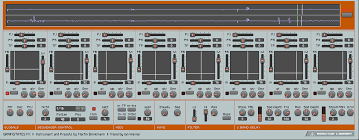 Native Instruments Reaktor changed this in the late 1990s and early 2000s. Reaktor's modular environment allowed working producers — not computer music academics — to build or download functional granular synthesizers for the first time.
Two ensembles defined the era. Grainstates SP, created by Martin Brinkmann, was a granular effect processor that shifted how producers understood grain-based processing: it was a live, performable tool, not a studio treatment applied to finished material. Travelizer introduced continuous position scanning across a sample buffer, turning the source playback position into an expressive, navigable instrument parameter.
Both ensembles directly shaped the design priorities of almost every dedicated granular plugin that followed. Real-time position control, scatter randomization, and grain density as a performance parameter are now industry-standard features precisely because Reaktor users spent years treating them as primary controls.
The Ableton ecosystem picked up the thread in 2012, when developer and Monolake co-founder Robert Henke released Granulator II for Max for Live. It made granular synthesis standard equipment for every Ableton Live Suite user, and its interface had a measurable influence on how commercial plugin developers presented granular controls in the years that followed.
Dedicated Granular Synthesis Plugins
These are instruments built around granular synthesis as their primary engine.
Audio Damage Quanta 2
Audio Damage Quanta 2 is one of the most rigorously implemented dedicated granular synthesizers available. It draws grains from an internal sample buffer and applies a full modulation matrix with multiple LFO shapes, envelope generators, and an onboard step sequencer. The parameter layout reflects a clear understanding of how granular synthesis is actually used — position and scatter controls are front-facing, not tucked into secondary menus.
Quanta 2 also ships as a CLAP plugin alongside standard VST3/AU/AAX formats, making it one of the better-supported options for non-standard DAW configurations. At its price point it competes with instruments that cost considerably more.

Dawesome Novum
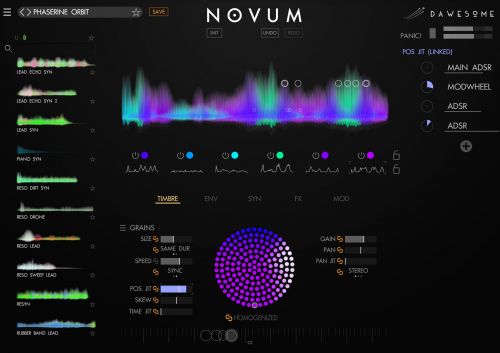
Dawesome Novum is the most architecturally detailed dedicated granular synthesizer currently available. It supports up to six simultaneous granular layers, each with independent grain controls, and incorporates a timbre follower that analyzes audio input and maps it to synthesis parameters in real time. Cross-synthesis — using one source to filter or modulate another — is built in as a first-class feature.
The modulation system is deep, MPE is fully supported, and the factory preset library demonstrates real range across textural, rhythmic, and tonal applications. Novum is not a quick-result instrument — the learning curve is real — but the ceiling on what it can produce is high.
New Sonic Arts Granite
New Sonic Arts Granite uses an unusual architecture: rather than processing the output of the granular engine, Granite applies filtering, pitch-shifting, and amplitude shaping at the individual grain level before mixing. This per-grain FX chain produces behaviors that standard granular synthesizers can't replicate, particularly in how grain-level filtering interacts with density and scatter settings.
The modulation routing takes some adjustment to learn, but the sonic results are distinctive enough to make it worth the time investment.
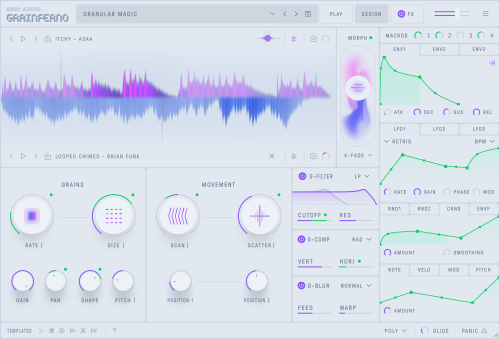
Baby Audio Grainferno
Baby Audio Grainferno is built for audio-rate granular processing — grain sizes short enough that the output enters timbral synthesis territory rather than textural. At very small grain sizes, granular synthesis starts to behave like additive or spectral synthesis, and Grainferno is one of the few instruments designed to operate comfortably throughout that range.
The interface is more approachable than Novum or Granite, and the price point is accessible. It's a strong first dedicated granular instrument for producers coming from conventional synthesis backgrounds.
Steinberg Padshop 2
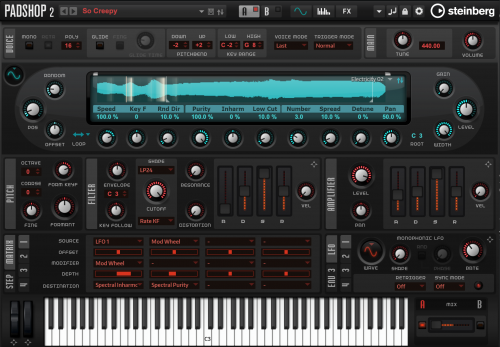
Steinberg Padshop 2 is a mature and often underrated option. Its two-layer architecture has been refined through multiple versions, making layered granular textures straightforward to construct and edit. The Cubase integration is tight, though it works reliably as a standalone VST/AU/AAX in any DAW.
Padshop 2 is particularly well-suited to pad and atmosphere work. It doesn't push the outer boundaries of what granular synthesis can do, but it executes its scope consistently.
Granular Engines in Multi-Synthesis Platforms
For producers who prefer a single instrument capable of multiple synthesis methods, these platforms include capable granular engines.
Arturia Pigments 7
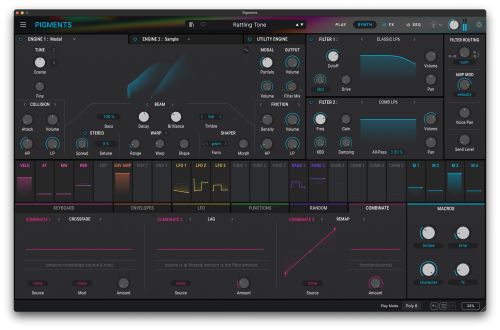
Arturia Pigments 7 contains one of the most fully realized granular engines available in a multi-synthesis context. The grain controls cover all standard parameters, modulation routing is drag-and-drop, and the interaction between the granular engine and Pigments' spectral and wavetable engines enables hybrid timbres that dedicated granular instruments can't produce on their own.
For producers who already own Pigments, the granular engine alone justifies spending time with the instrument.
Kilohearts Phase Plant
Kilohearts Phase Plant takes a modular approach: generators, effects, and routing are individual components arranged in a visible signal flow. The Granular generator functions as one source among many, which means granular processing can run in parallel or series with subtractive, wavetable, or sample-based components in a single patch. The flexibility is substantial, though building complex patches from scratch requires time.
UVI Falcon 3
UVI Falcon 3 includes a granular oscillator module that benefits from Falcon's broader architecture: deep scripting support, a large oscillator library, and a comprehensive modulation system. It's particularly practical for users building complex, evolving instruments that need granular processing as one component of a larger system.

DAW-Native Granular Options
Apple Alchemy (Logic Pro)
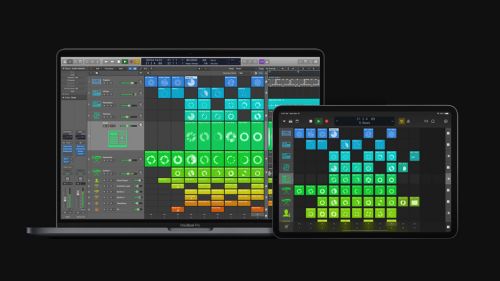
Alchemy, bundled with Logic Pro, includes a complete granular engine that is consistently underestimated. Its additive resynthesis, spectral, and granular engines can be combined in a single patch, and the modulation system is thorough. Logic users should spend time with Alchemy before purchasing any third-party granular instrument — it covers a large portion of the use cases.
Granulator III (Ableton Max for Live)
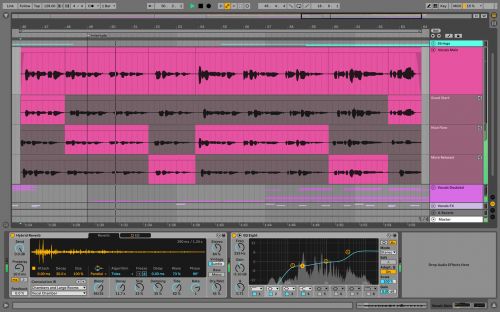
Granulator III is included with Ableton Live Suite and available separately for Max for Live users. Robert Henke's design has been refined through three versions, and the current release handles both performance-oriented and studio-focused granular synthesis well. Its direct integration with audio clips in the Arrangement view gives it a workflow advantage when working with existing audio material.
Granular FX Processors
These tools apply granular processing to audio signals rather than generating sound from scratch.
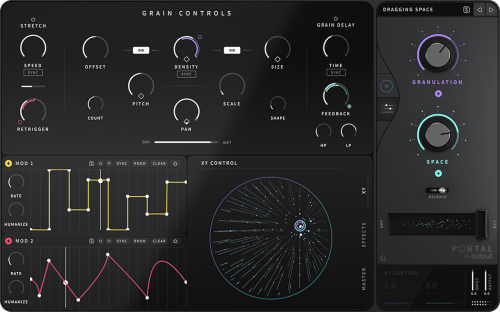
Output Portal applies granular processing to any incoming audio in real time, with a focus on musical usability. It performs well on bus channels and is one of the more approachable granular FX options available.
Arturia Efx FRAGMENTS is a newer entry with a strong modulation section and multiple grain-mode options. Its interface is hands-on compared to most granular FX processors, and the modulation options are deeper than the price point suggests.
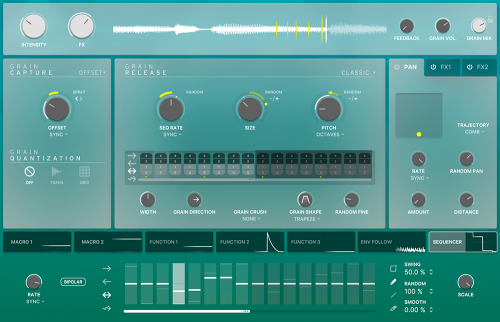
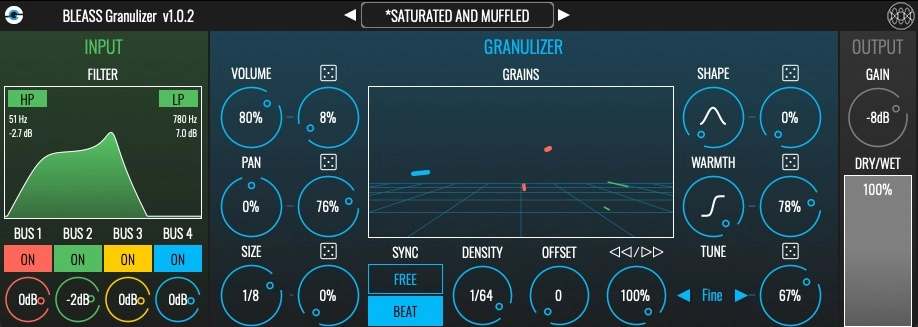
BLEASS Granulizer covers a practical range of granular FX applications at a lower price point. It handles percussive material particularly well and is worth considering as a utility granular processor for individual tracks.
Which Option Fits Your Workflow?
The right choice depends on what you need granular synthesis to do:
- Deep sound design with maximum control → Dawesome Novum or New Sonic Arts Granite
- Audio-rate and timbral granular territory → Baby Audio Grainferno
- Hybrid synthesis in one instrument → Arturia Pigments 5 or Kilohearts Phase Plant
- DAW-native starting point → Alchemy (Logic) or Granulator III (Ableton Live Suite)
- Dedicated instrument, clear learning curve → Audio Damage Quanta 2 or Steinberg Padshop 2
- Granular processing on existing audio → Output Portal or Arturia Efx FRAGMENTS
Granular synthesis rewards time and experimentation. The relationship between a parameter's technical function and its sonic result is often non-linear — which is a significant part of why it produces sounds that other synthesis methods don't.
Read More Best of

Discussion

You missed to quote HALion in the list. HALion features the same granular engine that powers Padshop, but on steroids. It's probably the most powerful granular synth available (definitely, one of the most powerful).

Padshop is listed under 'dedicated granular' which Halion is not... it is super powerful yes. I have a copy, although rarely use it though as I'm not a massive fan of the workflow. It should probably be listed here... there are probably tons of other products that I've inadvertently skipped too.

Thanks for the comprehensive, feature-wise, plugin/instrument guide about the granular synths in exisence. You just might have saved me from lots of forum gaze, potential candidates web-scrolling and what not? in order to gain insight of such potent tools of sound design available.
And also yes, I tend to buy attractive novel featured software to later actually learn what it really does, so having read a guide like this one, does clear the vision about the playing field at hand.
The historical perspective included is just an unexpected superb addition of wisdom to be shared...
The XX century musical development does result in tools as practical and deep as these, and to factually root them to the french side (GRM) of Electroacoustic history gives context and meaning to what many developers are presently doing.
Truly inspiring and helpful. Very grateful of reading and having this guide noted and knowledge ready for reference from now on.

Hi Nate,
SynthMaster 3 has a dedicated Granular oscillator as well, and it supports multisamples as well as single samples.
I haven't opened up Synthmaster in a while... forgot you guys added that in v3.
weird article Nate...there doesn't seem to be any coherence or metrics used to delineate objectively between products...nor chronological evolution...you missed out on tons of pivotal granular products...granular is one of the deepest plugin verticals out there...I can name like 30 freeware granulars off the top of my head for crying out loud...seems more like a sponsored ad than an "article"...and if that's the case, it's okay to just say so.
The product database would be your go to source if you want every granular product on the market... many of these here are products I have experience with. I guess a freeware section in the article would be appropriate, but again, they're all listed in the database. Not sponsored at all.. but we do link to the MP where appropriate.
The tone of the article reads as AI generated slop, so you are not far off. I wonder if the higher-ups at KVR are pushing for more and more slop? They already show a lack of care by using generated imagery (see the Mastering "guide" article), so generating articles for quick clicks is a no-brainer.
New granular synth: Phonon - https://www.kvraudio.com/product/phonon-by-polyfreq
Please log in to join the discussion